

The stock market remain volatile, but we’ll try our best to focus on fundamentals. Many of our holdings reported earnings recently and we’ll update those where relevant new information came through, plus a valuation update on these.
If you’re only interested in a few select companies, just scroll down to those you’re interested in. Hope you’ll enjoy this and have a wonderful week ahead!
Cheers,
Ole
Nordnet AB
Higher ambitions than we imagined
Nordnet has now become the largest savings platform in the Nordics. It ranks #1 among Nordic brokers, holds the largest market share among online investment platforms, and leads on Net Promoter Score (NPS) in Norway, Denmark and Finland (#2 in Sweden, behind Avanza).
Its strategy has been remarkably consistent: serve individual investors, innovate and distribute digitally and focus on the Nordics. This expands next month, when Nordnet launches in Germany.
The formula is straightforward but difficult to replicate: an ever-improving app, a steady stream of new products and competitors that struggle to innovate at the same pace. The result? Nordnet has been eating the incumbents’ lunch.
And lunch is the right analogy. The traditional leaders have largely been established banks such as Handelsbanken and DNB. They have struggled to match Nordnet’s pace of innovation in order to deliver the same user experience. Yet their broader banking businesses continue to generate substantial value (their dinner).
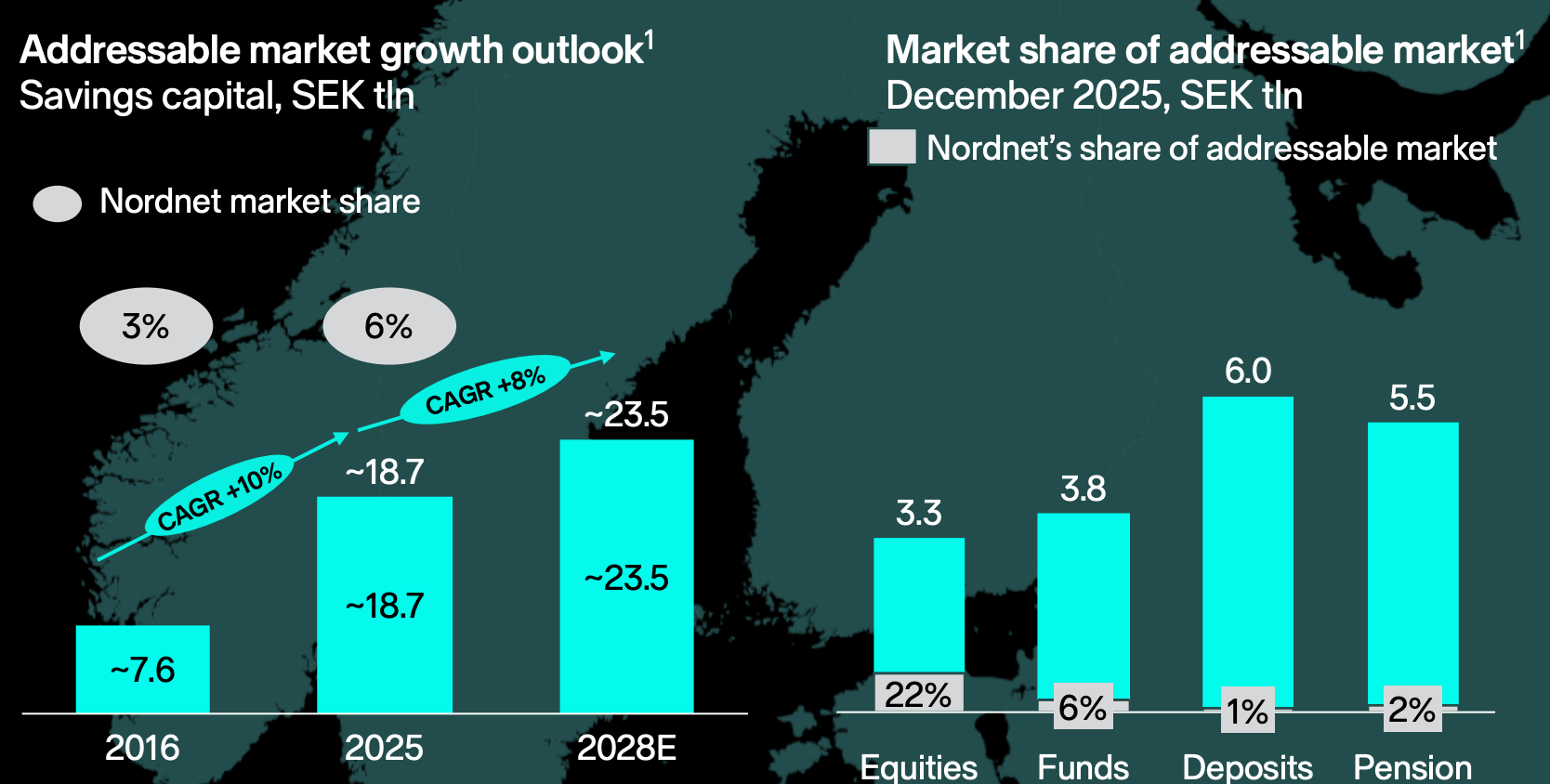
As the chart below shows, Nordnet’s share of total savings capital has now climbed above 6%. In equities — one of its core offerings — its market share has reached 22%.
However, management articulated an ambition that should put traditional banks on notice.
“Nordnet will earn the right to serve 100% of our customers’ wealth.”
That ambition goes well beyond brokerage. We’ve long believed Nordnet is well positioned to disrupt the pension market, where traditional banks often charge high fees for mediocre outcomes.
The typical offering is a 60/40 or 80/20 stock-bond allocation, with the equity portion spread across multiple overlapping funds, often at fees of up to 1.5% of assets. Customers are left with little clarity on what they own or how much of their returns fees consume over time. This creates a compelling opening for a transparent, low-cost digital platform, where customers are in charge themselves at a low cost.
With just 2% market share in pensions versus 22% in equities, Nordnet have a massive opportunity here. While their ambition is 100% of customers’ wealth, leaning heavily into the banking side would probably require much more innovation when it comes to AI, given that customer support there is much more challenging.
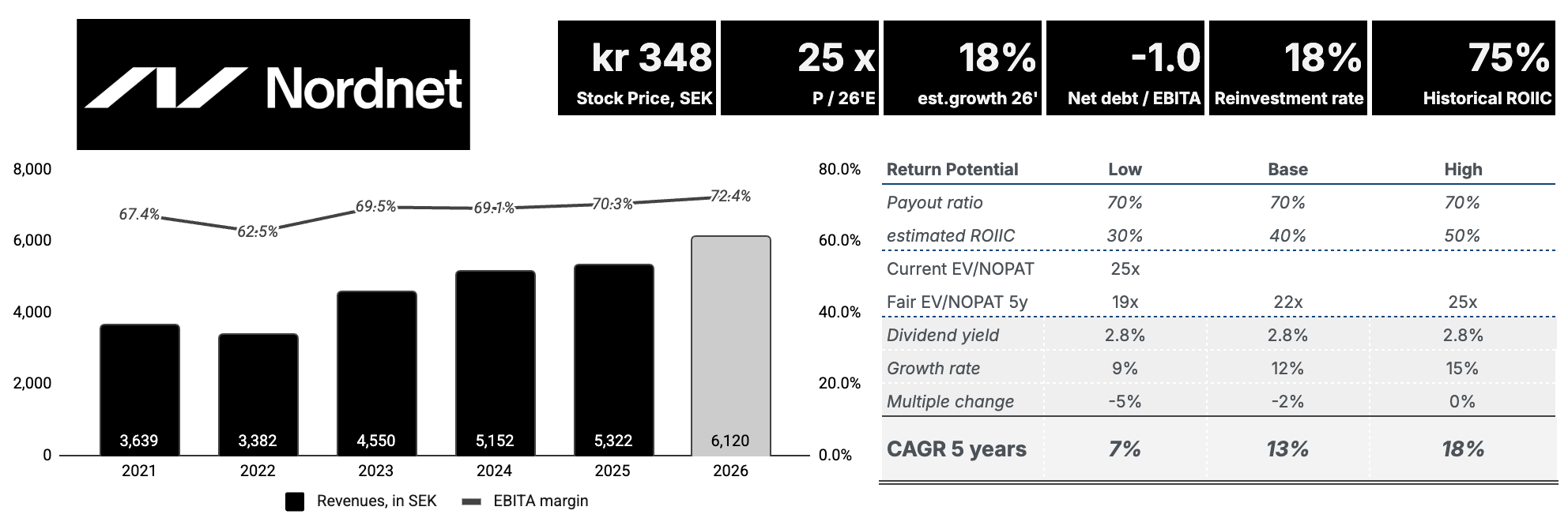
At a stock price of 348 SEK, Nordnet trades around a 25x PE for 2026 earnings. That’s no bargain price anymore (we first bought it closer to 15x), but execution still rock solid, so no good reason for it to trade cheaply yet. Earlier in the year we thought the combination of high commission income and interest income would prove a tough comparison point for future growth. So far, we’ve been proven wrong, with even higher interest rates and still very solid savings capital growth (which we’ve always been more certain on). We’re happy owned of Nordnet at these levels, but keep it a mid-sized position around 6% of our portfolio.
The big questionmark now is the upcoming Germany launch mid November. If they’re able to have a fifth market to grow into (much larger than the rest), that would definitely make for an interesting setup. But, even if that fails, we think the runway to capture more of the Scandinavian pension in particular remain very interesting.
