

Investor AB have increased their ownership in EQT in 2026. Given this and that EQT for the first time in it’s history is cheaper than Investor AB itself, we wanted to research the European Alternative Asset Manager with an incredible track record.
In short, we found that EQT’s market-beating investment returns and strong fundraising in recent years, have set themselves up nicely for the coming decade — with a long wave of carried interest not shown in today’s investment results.
Moreover, as institutional investors continue increasing their allocations to private markets — a market which have grown roughly five times faster than public markets since 2004 — capital is likely to continue concentrating with managers like EQT — with long and proven track records.
Disclaimer: This newsletter is provided for informational and educational purposes only. The views expressed are my own and do not constitute financial advice or recommendations to buy or sell any securities. The author may own shares in the equities discussed.
This writeup will be structured in 5 sections:
The Wallenberg Strategy: Long-term Active Ownership
EQT’s competetive advantage
How EQT makes money
The Wave of Carry
Acquisition of Coller Capital
Valuation
Long-term Active Ownership
From the beginning, our approach has been rooted in long-term, active ownership. We do not see ourselves as managing assets; we see ourselves as owners with a responsibility to develop companies and assets so they can thrive well beyond our period of ownership
— Conni Johnson, Founder and now Honorary Chair
Conni co-founded EQT in 1994 with the backing of Investor AB, where he was until then serving as Vice President. More than three decades later, Investor remains EQT’s largest shareholder and Conni serves as Honorary Chair. Investor AB has recently increased their stake to 14,7%, and continues to also be a major investor in EQT’s funds, and last year even co-invested with EQT to take Fortnox private.
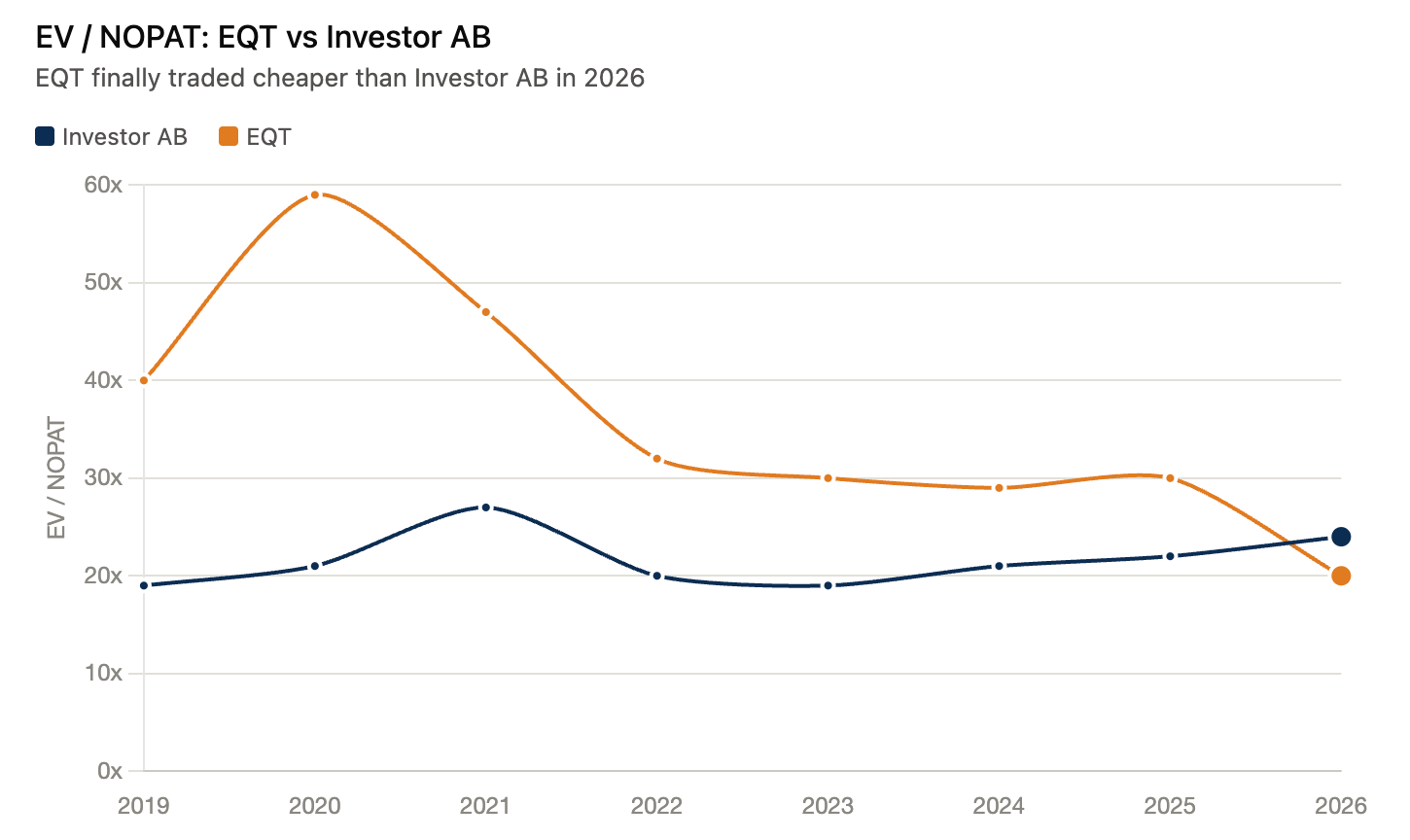
We have followed Investor closely for half a decade. Historically, EQT have been priced at a substantial premium, reflecting its faster growth, higher margins, and asset-light model. But that changed in 2026. For the first time in its history, EQT traded at both a lower valuation and a higher dividend yield than Investor.
EQT’s Competitive Advantage
Private equity is ultimately a business built on trust and track record. Pension funds and other institutional investors commit capital for more than a decade, making past investment performance one of the industry’s strongest competitive advantages. Once a manager has consistently delivered superior returns, investors are often willing to allocate more capital rather than switch to an unproven competitor.
EQT has been one of the industry’s biggest beneficiaries of this dynamic. Despite growing into one of the world’s largest private markets managers, it has continued to deliver attractive investment returns while steadily taking market share across private equity, infrastructure and real estate.
We believe this is supported by two structural advantages. First, EQT has built a strong ownership culture and compensation model that helps attract and retain experienced investment professionals. This is not something we say, their retention numbers are best in class — similar to many Wallenberg firms.
Second, the firm operates through locally embedded investment teams with significant autonomy, combining deep local market knowledge with the resources of a global platform.
Together, these advantages have allowed EQT to scale without sacrificing investment quality—a rare achievement in private markets. As long as EQT continues delivering strong returns, its reputation should reinforce a virtuous cycle: better performance attracts more capital, larger scale expands investment opportunities, and greater scale further strengthens its competitive position.
How EQT makes money
EQT is a giant within the Private Equity industry. Actually, they’re a clear market share gainer, now number 2 (from #7 in 2019) globally in size within Private Equity, and climbing within Infrastructure and Real Estate as well (#6→5 and #40→10).
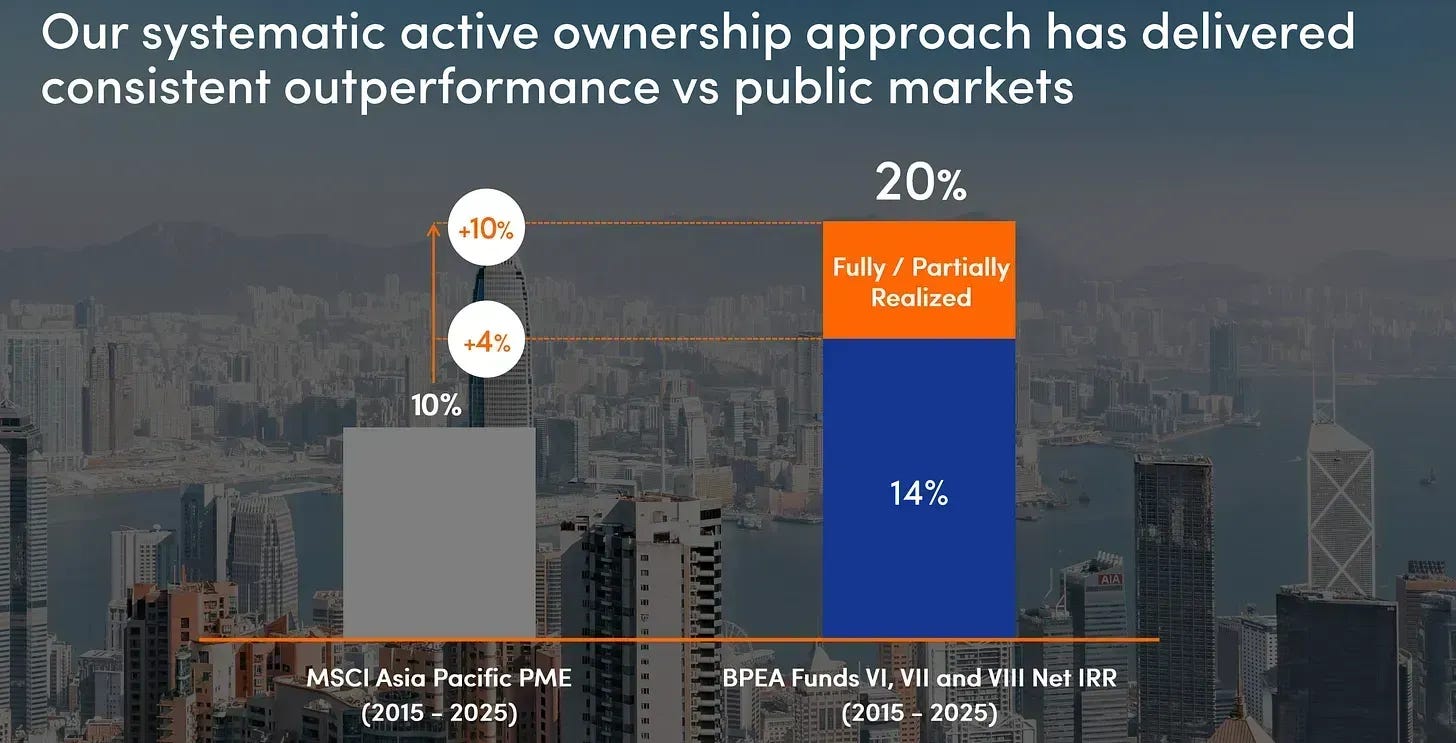
The key reason for this is simple: extraordinary investment returns. Below, you can see EQT’s outperformance vs public markets — 20% vs 10%. Although, one could argue comparing against MSCI Asia Pacific don’t make much sense. Still, the point stands even if comparing against a global index, which delivered ~12% over that time.
The way EQT achieved these extraordinary returns is also notable. Looking at the infographic below, we can see most of the returns came from sales growth and margin expansion — suggesting businesses under EQT ownership improved. Additionally, EQT benefited from a dual engine with multiple expansion, likely as a result of the higher business quality achieved during their ownership.
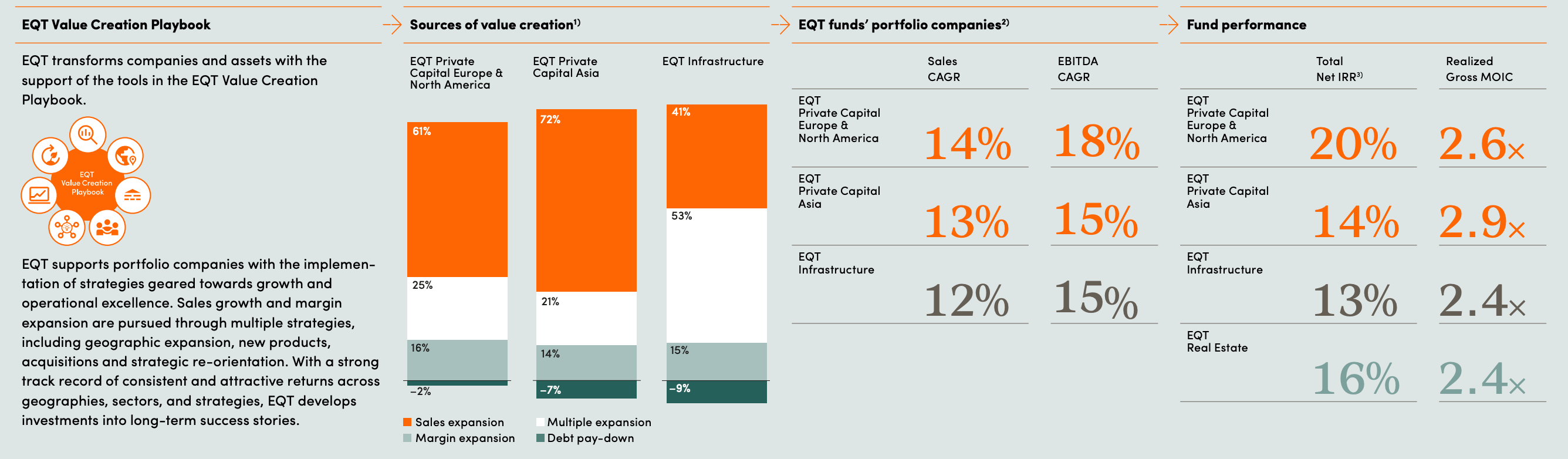
We think EQT’s strategy of buying high quality companies, similar to that of Wallenberg’s Investor AB, is a durable strategy. We wouldn’t be interested in EQT if they delivered these returns from financial engineering or adding risk through leverage for instance. EQT have proven they can generate attractive returns at modest risk levels (meaning little reliance on leverage and a diversified portfolio).
These returns are what EQT’s clients — such as pension funds, sovereign wealth funds, asset managers, insurance and other stakeholders — are willing to pay EQT to generate for them.
EQT monetizes their investment skill in two ways: management fees and carried interest (”carry”).
Management fees are similar to how individual investors would pay 1-2% annually for an actively managed fund. As EQT launches new and larger funds, fee-generating assets grow — resulting in a predictable high-quality earnings stream.
Carried interest is more complex, but is the performance-based upside. After investors receive their capital back and and achieve a minimum return (often 6-8%), EQT holds 20% of the remaining profits. Carry is therefore less predictable than management fees, but highly profitable, as it requires little incremental costs for EQT.
The math is a bit complex, but the picture below illustrate a typical fund’s carry well.
From a fund delivering a 2x return ($1→2), EQT here charged 12 cents over the lifetime of the fund in management fees. The 88 cents in fund profits after management fees are split 80 / 20 between EQT and fund investors. From here, another split of 35 / 65 are between EQT AB as a company and it’s professionals. Consequently, EQT’s highest performing employees earn incredible salaries.
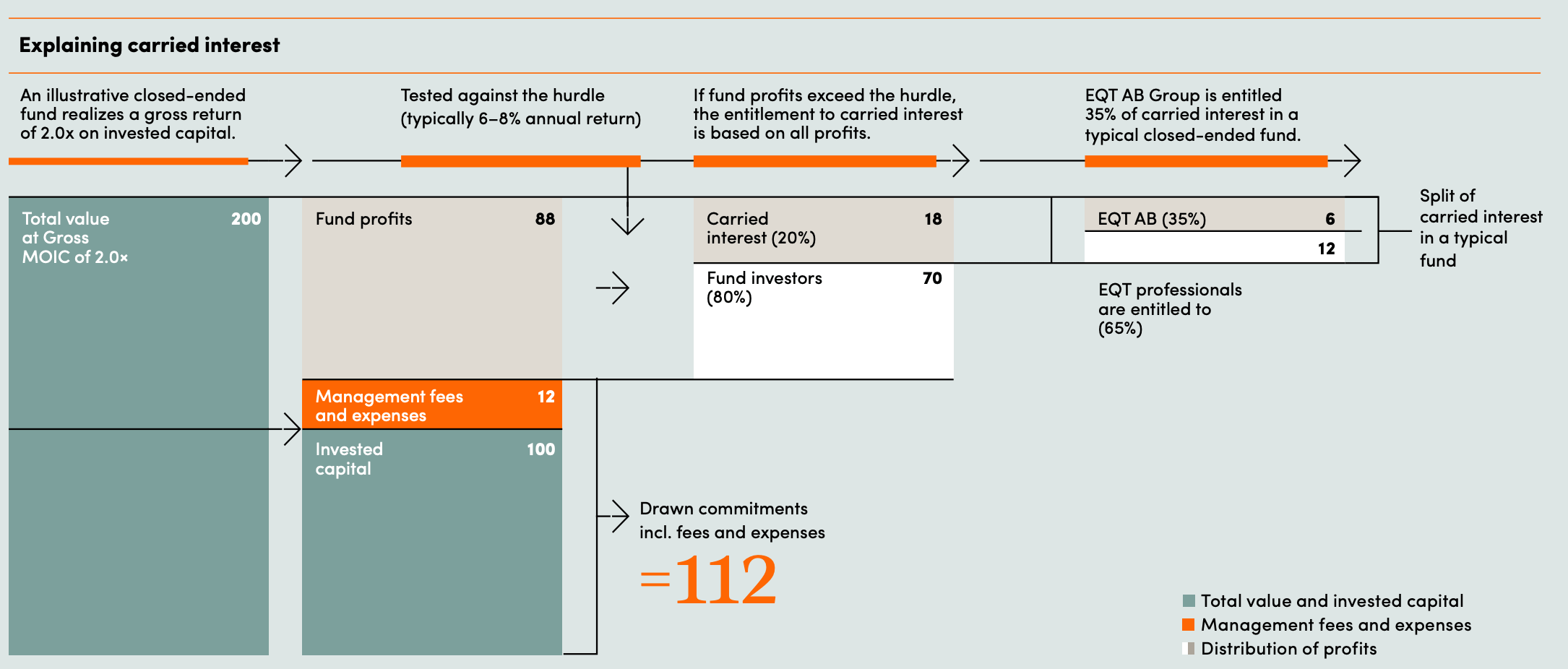
In simple terms, management fees provide the durable base and carry provide upside. And in the illustration above, a fund with a 2x return: EQT AB would earn 12% + 6% of their clients Invested Capital base over the lifetime of the fund.
While simplified, that math would imply today’s fee-generating assets under management (FAUM) of €155 billion could yield €28 billion over it’s lifetime.
If returns are like EQT’s historical performance, much higher than the 2x over a 10-year fund for instance, the value would be much higher from the carry.
If we take a quick look at EQT’s funds below as of Q2 2026, we can see to the far right, that the funds prior to launching 2020 are all with returns from 2,0 → 2,7x, and all other funds are also Above plan or On plan for the Expected Gross MOIC.
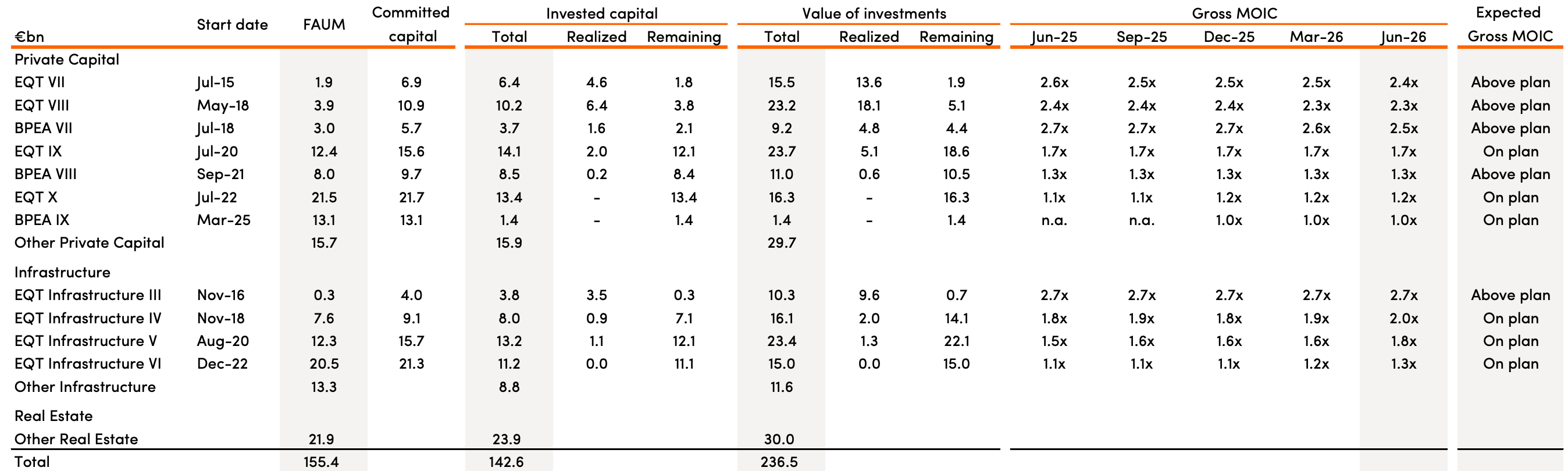
In the current fundraising cycle, we can see that funds like EQT Infrastructure VI from 2022 is only halfway invested, and BPEA IX launched in 2025 is less than 10% invested. From Dec 25 until June 2026, we saw the total Invested Capital go from €127 → 143 billion, meaning EQT is currently deploying capital in these funds.
In the older funds, we see EQT VII and EQT VIII have increased realized capital and less remaining capital than at year end. This means these funds are slowly being realized, capital is returned to clients and the carried interest is realized.
But a key observation here, is that the FAUM for the funds launched before 2020 is just €16,7 billion of the €155,4 billion in FAUM as of today. This means that EQT have already secured a stable earnings streams for many years, and are well on the way to secure a long wave of carried interest from the “above plan” funds in particular.
The Carry analysis, Acquisition of Coller Capital and the Valuation section will be exclusive for paid subscribers. A subscribtion currently costs €75 per year or 12 per month. Subscribers keep their rate if prices go up in the future.
And if you got interested in learning more about EQT, we can recommend Business Insiders’ podcast of EQT: Returns at Scale.
EQT’s Next Wave of Carry
Earlier we explained how carried interest works economically. Timing, however, is just as important.
Unlike management fees, which begin immediately after a fund is raised, carried interest typically arrives years later. EQT generally earns management fees from day one, but meaningful carry is usually not realized until investments are exited—often beginning around year four and continuing throughout the remaining life of the fund.
The chart below illustrates this relationship.
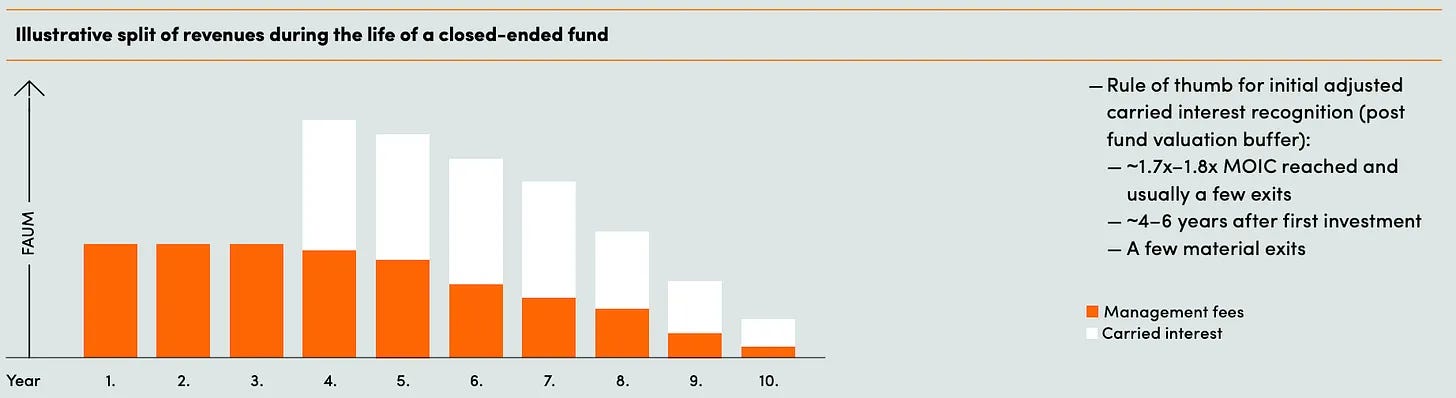
Historically, EQT’s funds have tended to realize relatively little carry during their first few years. Instead, exits accelerate later in the fund’s life as portfolio companies mature. Carry is only earned once investors have received their 6-8% return and the fund has generated sufficient profits, meaning timing ultimately depends on both investment performance and the exit market.
This timing matters because EQT experienced an extraordinary fundraising cycle between 2020 and 2023, launching several of the largest funds in the firm’s history. A similar dynamic occurs today, with the launch of EQT XI, additional strategies, and the acquisition of Coller Capital.
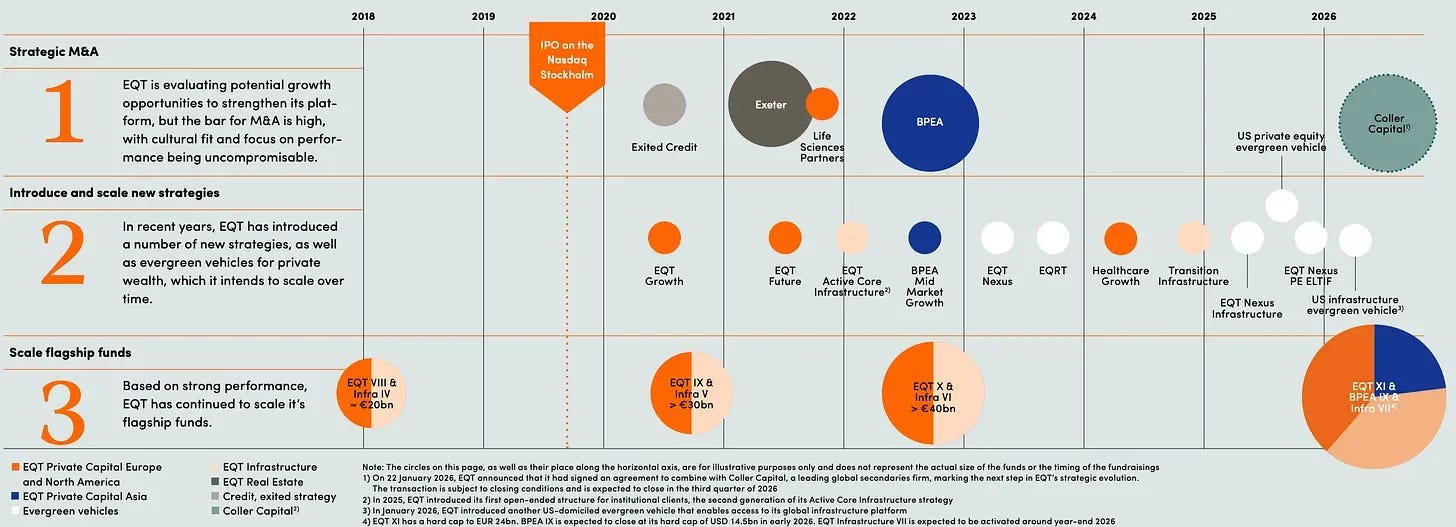
Those 2021-2023 funds are approaching the stage where exits normally begin. Let’s look closer at why we believe the upcoming cycle of carry will be unusually large.