

NEKKAR
Late 2024, we shared our investment idea for a small Holding Company called Nekkar. Nekkar’s stock price was then a bit less than 10 NOK. One and a half years later, the stock is up ~50% and Nekkar is now a NOK 1,4 billion company.
Ironically, we think the investment thesis may have improved.
We recommend reading our first writeup to understand the different parts of this Norwegian industrial holding company, specializing in ocean-based industries.

The biggest change in the investment thesis is that Nekkar itself has changed.
From the lumpy cash-cow Syncrolift + venture capital-like bets into a group of profitable platforms, investing their cashflows into acquisitions at low prices. And on top of that, Syncrolift about to be a late-cycle defence beneficiary.
The bull case for Nekkar is that Syncrolift, the global market leader in shiplifts, will be a late-cycle beneficiary of defence investments, especially in Europe.
On top of that, Nekkar’s previously unprofitable “other bets” have become profitable fast growing platforms, also doing bolt-on acquisitions themselves. Making the reinvestment runway much clearer than it was last time we wrote about Nekkar in 2024. Management have stated an intention to stop doing early-stage investments.
In total, our thesis is that Nekkar in 2-3 years time will look like a much higher quality company than it have been viewed historically. We don’t envision it to get the typical “serial acquirer multiple” of above 20x earnings, but from a starting point of high single digit multiples to 2027 profits in our estimates, we think the investment case looks interesting.
In the last strong cycle (2021 → 2024), Syncrolift delivered annual EBITDA of around 125 million. We expect the next cycle to be larger, driven by Syncrolift’s ability to capture a portion of the 8,7 billion current Tender Pipeline — which is roughly 13x larger than Syncrolift’s current order backlog. The question is just how much of this Pipeline will turn into orders, and more specifically, how much of that Syncrolift takes over competitors. If it’s anywhere close to the 60% market share over the last decade, Syncrolift will have a massive order backlog to work through in the coming decade.
No wonder analysts expect a massive inflection in revenues for 2027, with 90% growth from 2026 levels, with topline of 1,4 billion NOK (0,6b in 2025). EBITDA is also expected to inflect dramatically upwards, expected at 280 million.
When we reverse engineer that 280m estimate, we think it sounds optimistic.
Assuming Syncrolift EBITDA 33% above all-time highs reaching 200 million, 15% organic CAGR for Globetech plus the newly acquired Satco and a 30% organic CAGR for Intellilift, only arrives at a combined 290m (200+50+40). Then, we have to deduct group functions around -30 million, to arrive at 260m. We assumed no profit contribution from Fiizk and Techano yet, but that would definitely help.
And we think the above napkin math is quite optimistic. If we take a haircut from our estimate to 250m EBITDA in 2027, Nekkar trades at just a 5x EV / 2027 EBITDA.
Given the minimal maintenance capex required, that should convert well into earnings and cashflows — implying a high single digit forward PE multiple.
Now let’s look closer at what’s happened to Nekkar since last time.
What has changed since 2024?
We believe there are 2 major changes since 2024. Syncrolift, and the transition from a venture-capital investment arm to several profitable platform holdings.
1) Syncrolift
Syncrolift, Nekkar’s historical cash cow, has struggled to convert a promising tender pipeline into orders, just like their competitors. In 2025, there wasn’t a single order for a new shiplift in the whole world. And since 2021, order backlog has been on a steady decline, with revenues first falling off a cliff in 2025.
A shiplift may take 3 years to build, but a submarine can take a decade. That supports the theory that Syncrolift’s orders come late in a defence cycle.
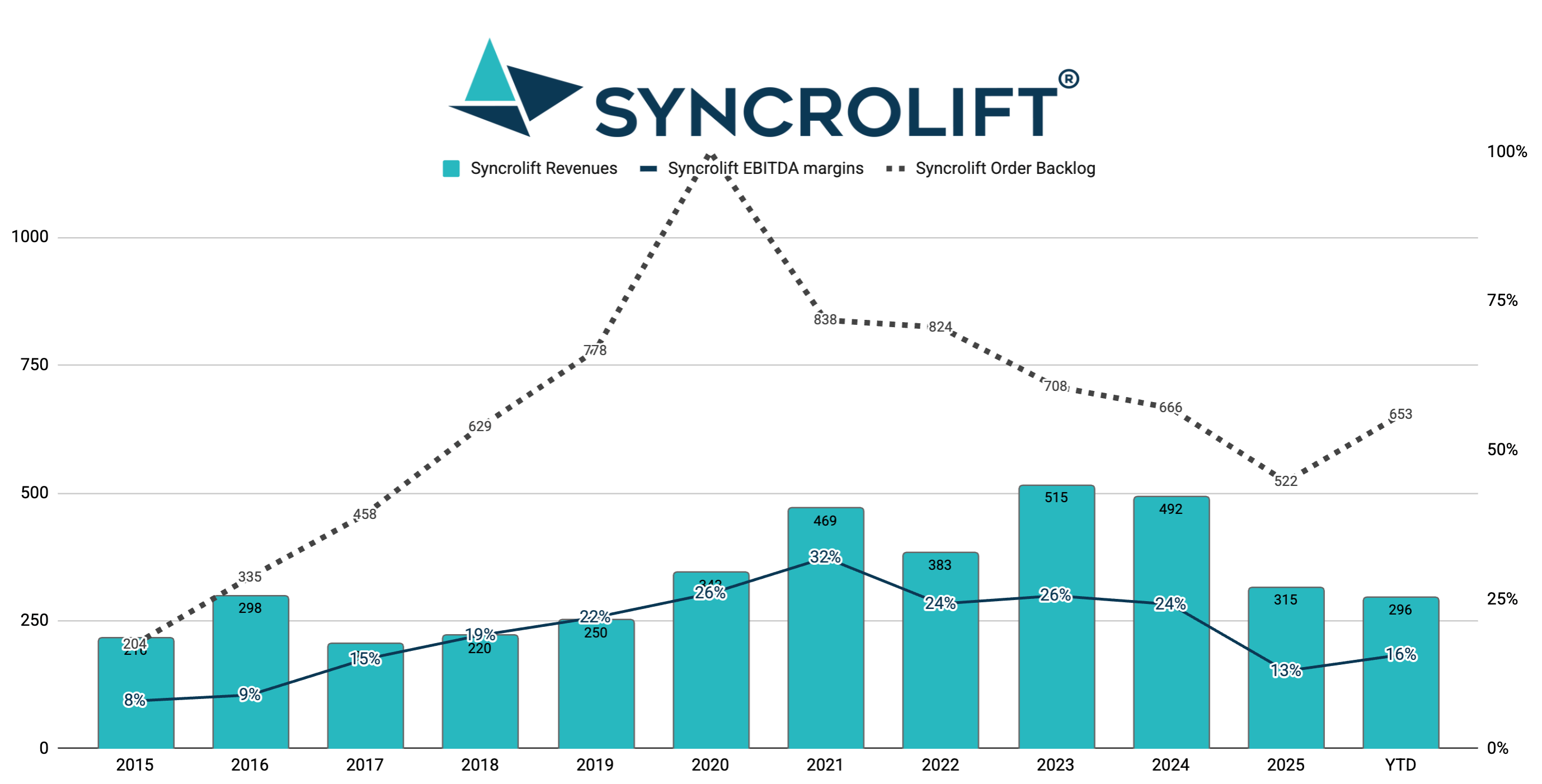
While orders have been shrinking, Syncrolift has improved revenue quality. 37% of revenues in 2025 was tied to service — meaning more recurring revenues. Nevertheless, Syncrolift remains a very lumpy business, impacted by newbuild timing.
Fortunately, Syncrolift is capital-light with outsourced manufacturing, and benefits from negative working capital, with customers paying a large portion of costs upfront. Thus, Nekkar can reinvest Syncrolift’s lumpy cashflow elsewhere in their portfolio.
The big question is if orders will inflect upwards. Syncrolift have won 1 of 2 contracts awarded in 2026 — an 8,5 million EUR shiplift and transfer system in Egypt.
With European defence spending increasing rapidly, we find it hard to imagine that investments in naval infrastructure will not follow. This could come through upgrades to existing ports or new infrastructure, for example as countries increase submarine fleets.
Syncrolift should be well positioned when this spending eventually reaches the shipyard and maintenance infrastructure. The company has historically held roughly 60% of the new shiplift market, 70% of ship transfer systems, and as much as 90% of submarine lifts — particularly relevant for defence customers.
Nekkar’s historical cash-cow Syncrolift, remains the most important piece. But, behind Syncrolift an impressive transformation have occured. Previously venture capital-like bets have become profitable, and Nekkar seem to now have 5 different platforms to grow from, either organically or through bolt-on acquisitions.
A cyclical business like Syncrolift is typically assigned a low earnings multiple in the stock market. If Nekkar’s other holdings contribute counter-cyclically or balance out this, the market may assign a much higher earnings multiple on the group.
But the big thesis changer, is if Nekkar becomes an advantaged acquirer of ocean-based industrial technology companies, with clear reinvestment opportunities at high incremental returns.
2) Rest of Nekkar
In 2024, Nekkar ex Syncrolift looked more like a venture capital arm than a group investors would assign much value to.
This has changed dramatically.
Intellilift had 1 installed rig at the time. Today, they have 6 with another 11 (!) ordered. With 30% gross margins on installation and 80% on software, Intellilift’s EBITDA margins could inflect much higher than the current 30% over the last year.
Globetech, the IT and cybersecurity platform Nekkar acquired in 2024, continue to see a rise in contracted vessels, now at 224 in total. The two bolt-on acquisitions of Firstpoint in Q3 2025 and Satco in Q3 2026, added with Firstpoint 23 vessels in a new geography and with Satco, the ability to vertically integrate now also with hardware.
A highlight for us was seeing the acquisition of Satco at a low single-digit EBITDA multiple. This implies a high incremental return on capital, and strengthens the case that Nekkar could be an advantaged acquirer of ocean-based companies.
FiiZK, the clear market leader for closed-containment solutions for fish, has established proof of concept through deliveries with Mowi. Beneficial regulations also help Fiizk. Nekkar taking ownership from 39 → 100% this quarter is a clear sign they believe Fiizk is ready to scale, and Fiizk’s P&L will consolidate into Nekkar’s from Q3.
Techano Oceanlift is still earlier in its lifecycle, but margins have improved towards breakeven as of Q2 2026. It needs more orders to become profitable, but at least it should no longer weigh materially on group profitability.
The result is a portfolio that is becoming more balanced, with businesses that can contribute to a higher and steadier earnings power going forward. And just as importantly, with clear places to invest the group’s cashflow. This means the business quality behind Nekkar has grown substantially since our last update.
We have presented the case for Syncrolift being a late defence beneficiary, as well that Nekkar’s other holdings are becoming increasingly profitable. Still, Syncrolift should remain the key earnings driver at least for the next few years. But when it comes to capital allocation, there’s little doubt for us that Nekkar aims to be an acquirer of ocean-based industrial technology companies, and use Syncrolift’s cashflow for this purpose.
Capital Allocation
It’s important to recognize what Syncrolift being capital-light really means. Negative working capital and outsourced manufacturing, has two key implications. Cash conversion remain high and capital requirements are low. If Nekkar invested to insource manufacturing for instance, this would make the group more cyclical. Thus, it makes complete sense in our mind to reinvest Syncrolift’s cashflows elsewhere.
Nekkar’s growth ambition is to invest in opportunities that support their 2027 ambitions — to deliver 2 billion in revenues with solid profitability.
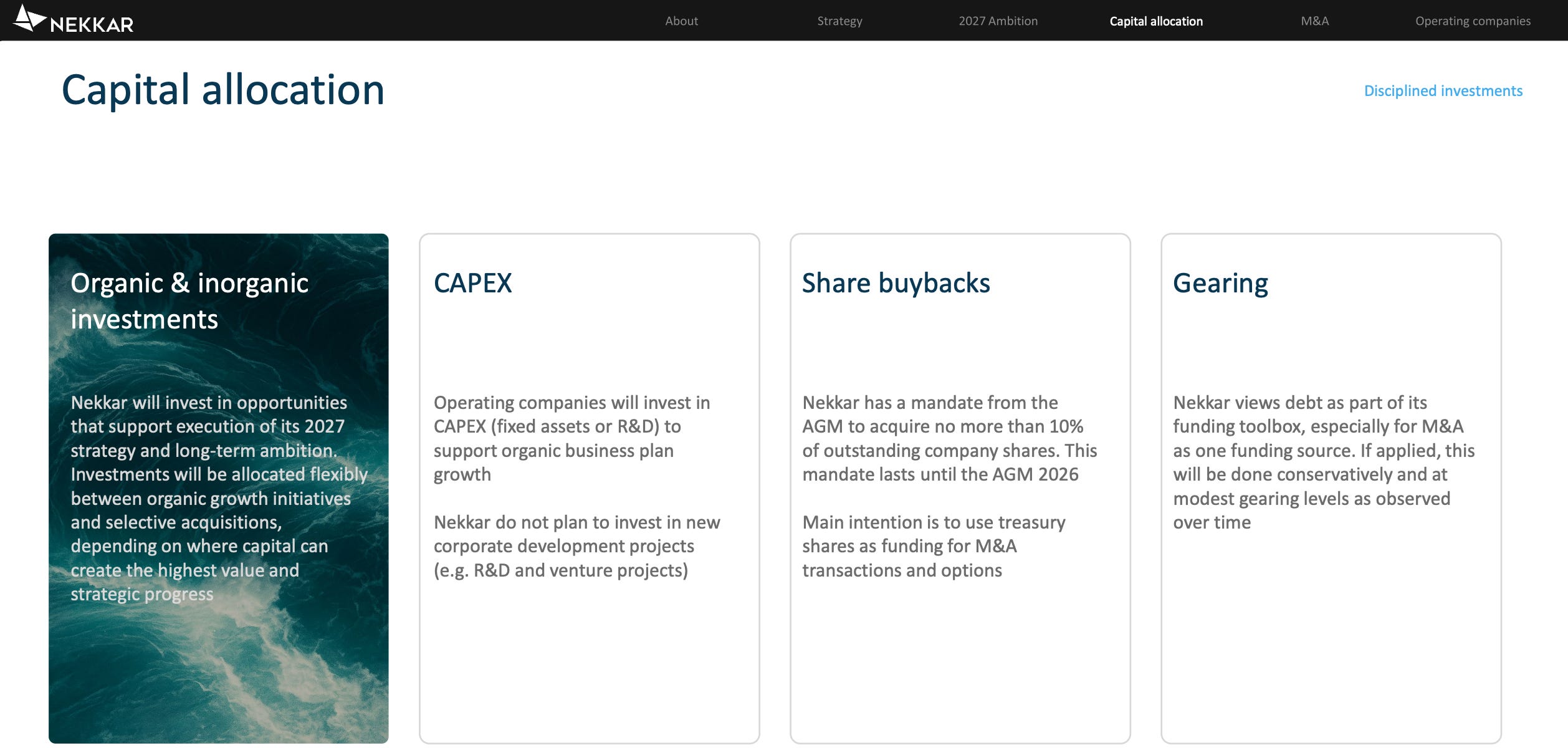
We were skeptical seeing the 2 billion 2027 revenue target, as it represents a 33% CAGR from 2024 figures at the time they disclosed it.
But, after pulling the pieces apart — 1,5 billion was envisioned from existing companies — suggesting a 21% CAGR. If we also assume roughly 200 million contribution from taking Fiizk and Globetech to 100% ownership, it’s closer to 16% growth. And much of that likely comes from a belief in Syncrolift’s defence cycle.
Still, if they seek to acquire inorganic sales generating 500million+ in 2027, this would imply a massive cash spend from today’s level. At a targeted 15% EBITDA margin and a 0,8x sales multiple (6x EBITDA), that would require 400 million of acquisition spend.
While many companies employ optimistic sales targets, the key thing we watch out for is the potential return on these incremental investments (ROIIC).
Let’s break down the first data we have on the implied ROIIC on acquisitions.
In 2024, Nekkar acquired 67% of Globetech at 5,5x EV / EBITDA, with an option to increase ownership to 100% in 2028. The price for the reminding 33% is expected to be 59 million NOK — giving a total EV of 146 million NOK.
In 2026, they acquired 60% of Satco at “low single-digit EBITDA” multiples, in a similar deal. Satco has a track-record of double-digit growth and just delivered 45million in sales and 26% EBIT in 2025.
Even assuming no synergies for Satco + Globetech, a purchase price around 5,5x EBITDA and a 73% after-tax profit conversion (22% tax + 5% maintenance capex), would yield a 13-14% year 1 ROIC. Considering both these companies have a track-record of double-digit growth, we would classify these as great purchase multiples.
Their decision to leave a large ownership portion to be paid from future earnings, also aligns interest in the first years after purchase, but also reduces the immediate cash outflow for Nekkar. In addition, Nekkar tend to buy out these last portions with treasury shares. Currently 65 million worth of bought at a 40% discount to today.
In total, we see these as the first signs that Nekkar is developing into an advantaged acquirer of ocean-based industrial technology companies.
By advantaged acquirer, we’re thinking of something like a preferred owner, being able to get certain deal targets below what the average market participants would have to pay for it. The reason why can be many, but we’ve seen this with companies like Lifco, Lagercrantz & Addtech.
Runway to Invest Inorganically
During Nekkar’s 2025 Capital Markets Day, they shared that their deal flow consists of a longlist of 3000+ companies, with roughly 10 in early discussions at the time.
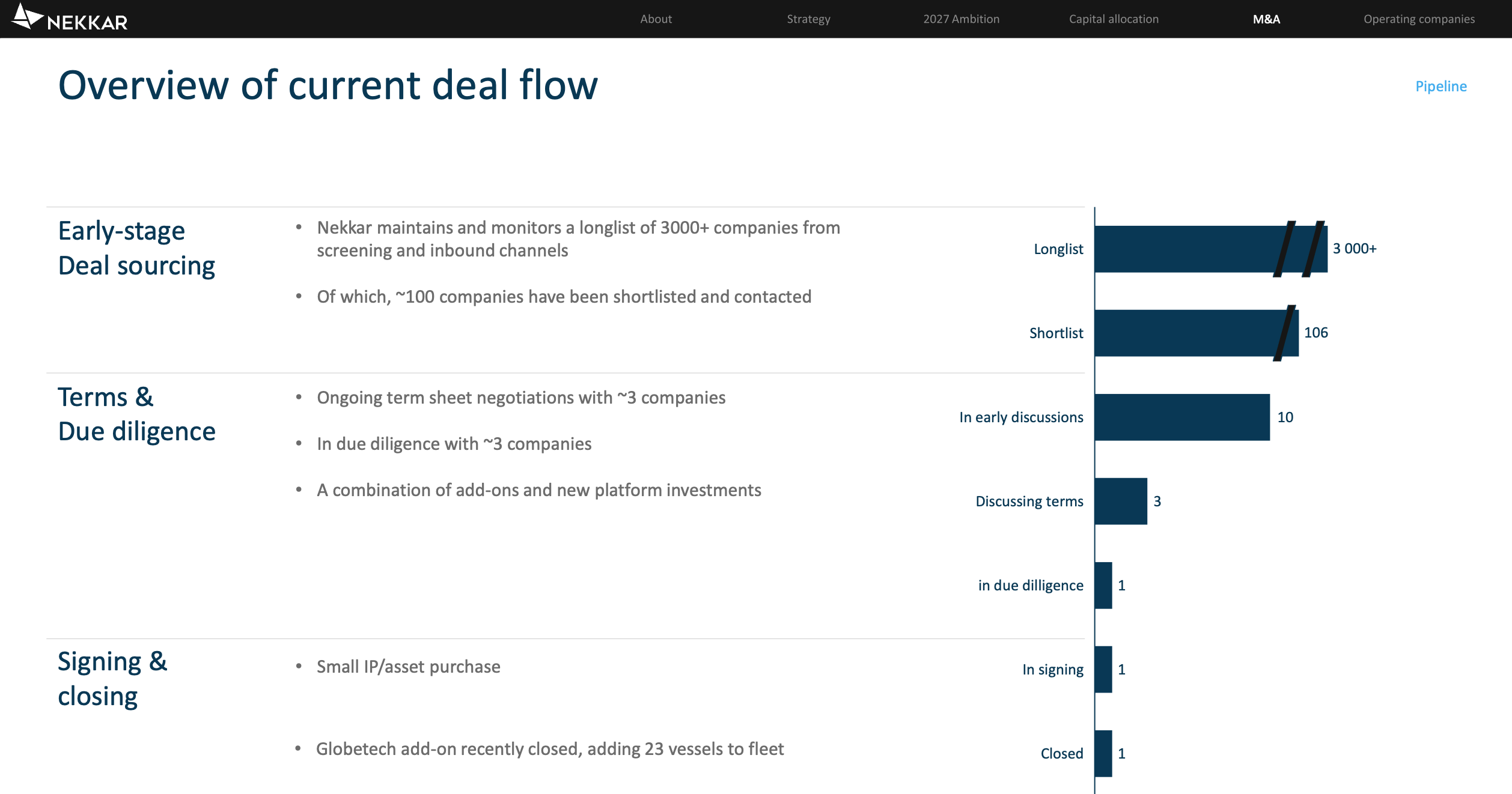
A very positive sign in our opinion, is that Nekkar are price sensitive.
— “Nekkar expects to lose a share of investment targets pursued as it remains disciplined to its return requirements” (source)
By positioning themselves as a long-term owner for ocean-based industrial technology companies, Nekkar may be a preferred owner for many smaller ocean-based companies — especially those that cater to similar client groups as one of Nekkar’s preexisting platforms. We would expect mostly bolt-on acquisitions, but perhaps a few platform acquisitions over time for Nekkar too.
We summarized the development below, with consolidated figures for the 4 operating companies of today. Fiizk will be consolidated from next quarter.
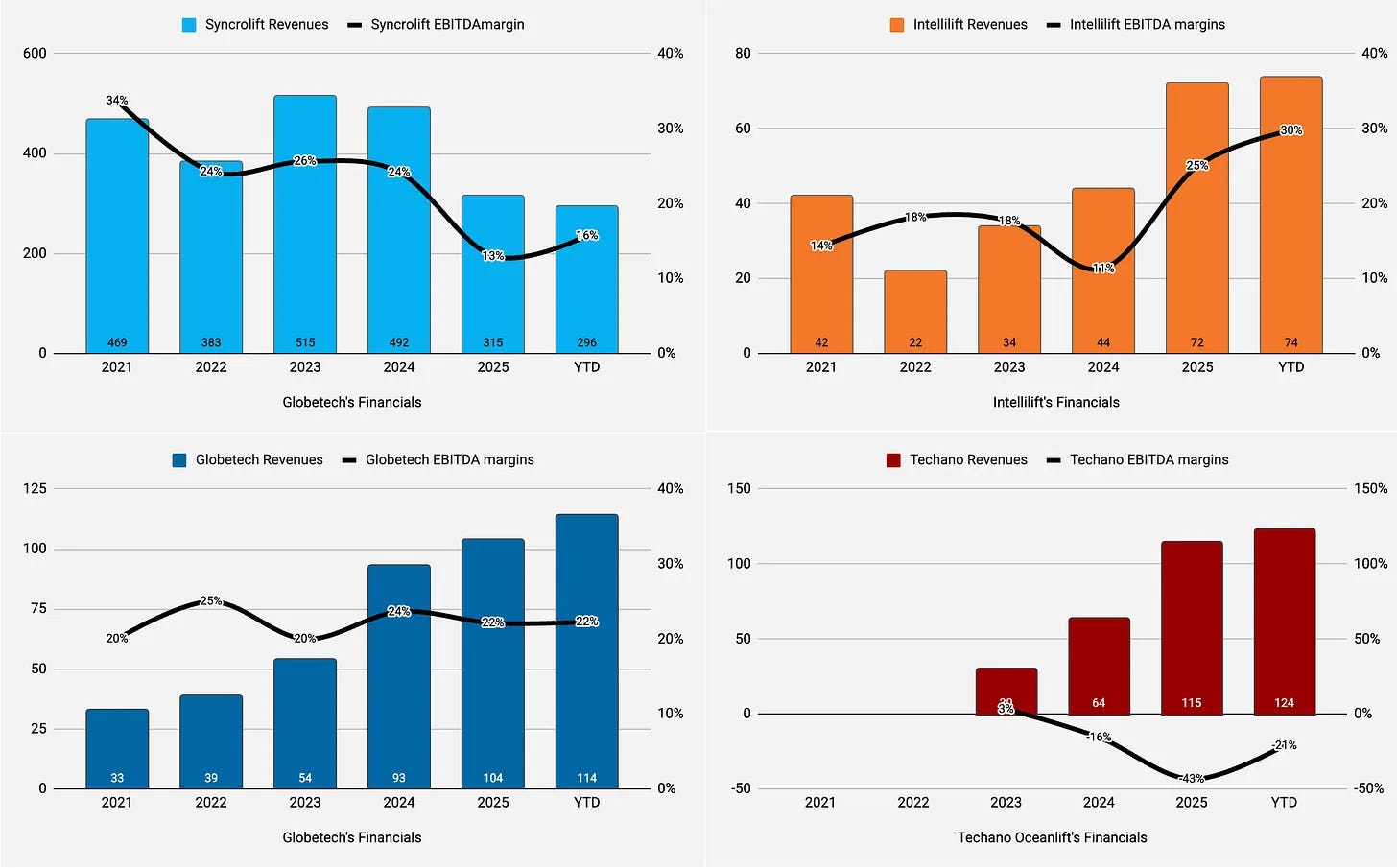
If you want to look closer at the individual subsidiaries, we recommend Nekkar’s Capital Markets Day and the Q2 2026 report.
Valuation
We believe Nekkar is best valued by separating the core operating businesses from the additional optionality represented by FiiZK, Techano and Nekkar’s balance sheet.
Core operating businesses
We find it useful to start with the three businesses where earnings visibility is currently strongest. Analyst estimates point towards approximately NOK 290million of EBITDA for Nekkar in 2027, depending on the source. We have taken a more conservative approach and modelled these businesses ourselves based primarily on what we know today.
Our base case implies NOK 230 million of EBITDA in 2027 — from Syncrolift, Intellilift and Globetech alone.
After deducting roughly NOK 30 million of corporate G&A, this implies approximately NOK 200 million of EBITDA for the group before assigning any value to FiiZK or Techano.
Given Globetech and Intellilift’s long reinvestment runway, Syncrolift’s market leadership position, and what we believe is a short, but promising acquisition track record, we think a valuation of approximately 10–11x normalized EBITDA is reasonable at this point. This gives a core enterprise value of approximately:
NOK 200m EBITDA × 10 – 11x = NOK 2.0 – 2.2bn
It remains to be seen whether Nekkar could arrive closer to the analysts estimates. We’d rather be conservative here, than assume full credit for future execution.
Techano Oceanlift
Techano generated approximately NOK 124 million of revenue over the last twelve months, while recent results indicate that the company is approaching EBITDA breakeven as its market-entry investments mature.
We therefore assign Techano a modest NOK 75 million equity value.
This is deliberately conservative: it represents only a fraction of its trailing revenue and assumes little value for future margin expansion. If Techano can establish sustainable profitability, we would value the business considerably higher.
FiiZK
FiiZK is more difficult to value. The business is still far from profitability in 2025, with gross margins remaining negative at approximately -5%, although operating expenses as a percentage of revenue have been moving in the right direction.
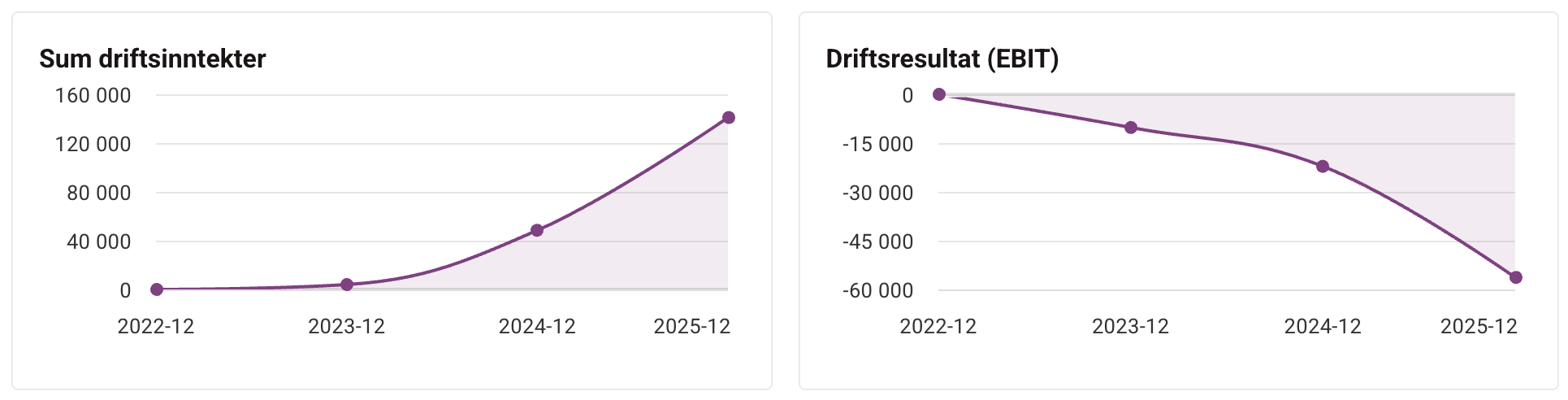
The strategic refocus is nevertheless encouraging. FiiZK has divested most of its non-core assets and is now concentrating primarily on its closed-containment systems for fish farming. Nekkar’s decision to take full ownership this summer also suggests management sees sufficient potential to justify consolidating the business and capturing the full value of a potential margin inflection.
Including the original investment, Nekkar has now invested approximately NOK 120 million in FiiZK. Assigning zero value to a business with an established product offering, installed systems and a substantial revenue base seems unnecessarily harsh. Still, we don’t want to give it full credit before profitability is closer.
We therefore assign FiiZK a conservative NOK 75 million equity value.
This still values the company at almost half of Nekkar’s cumulative investment and leaves essentially all of the potential upside from a successful development outside our base case.
Net cash and treasury shares
Nekkar also has a strong balance sheet. As of the latest reported quarter, the company held approximately NOK 90 million of net cash, in addition to treasury shares.
We assign approximately NOK 65 million to the treasury shares and therefore include roughly NOK 150 million of balance-sheet value in our valuation.
Sum-of-the-parts valuation
Putting this together:
Total equity value of NOK 2,3 – 2,5 billion.
Using approximately 102 million economic shares, this corresponds to roughly NOK 22 → 24 NOK per share. Given that Nekkar trades at 14,7 NOK today, it’s clear we find the company undervalued. This explains why we think the investment case may be better today than in 2024, despite the higher shareprice.
Holding Companies however, typically trades at discounts to Net Asset Value. Subsequently, you could argue for a haircut to a Holding Company like Nekkar. Even with a 20% discount applied, the fair value would still be 18 → 19 NOK per share.
Risks
And here comes the last part: Risks. As always we can’t know the future.
The largest near-term uncertainty in our valuation model is the assumption that the Tender Pipeline will soon turn into orders. We cannot know how much of today’s pipeline will ultimately convert into firm orders. Even if the underlying demand is real, projects can be delayed, cancelled or won by competitors.
There is also no guarantee that Syncrolift will win the tenders that do proceed. Depending on the market and geography, competition could come from Pearlson Shiplift or lower-cost Chinese competitors.
That said, we believe Syncrolift is well positioned to capture it’s share of the European defence investment cycle, particularly as European governments increase defence spending and upgrade existing naval infrastructure while investing in newbuild capacity. We also see a reasonable possibility that Syncrolift benefits from its established track record and installed base in these markets.
Their main competitor, Pearlson Shiplift, may now have a structural advantage securing US orders - given the increased focus Trump has on inshouring.
Ultimately, if today’s Tender Pipeline does not convert into orders, or if projects are repeatedly pushed out, our valuation would need to come down. This is perhaps the most important risk to the 2027 earnings case.
Risks across the portfolio
Beyond Syncrolift, Nekkar’s other portfolio companies carry a range of risks that are difficult to quantify today. The diversified nature of the holding company provides some protection, as weakness in one business does not necessarily impair the entire group. Nevertheless, there is one risk we believe deserves particular attention: cybersecurity.
Several of Nekkar’s businesses operate software and technology that are connected to critical infrastructure.
Intellilift provides software for offshore oil and gas installations. Globetech delivers software and security solutions to more than 220 vessels operating at sea. And Syncrolift provides shiplift systems that are used in strategically important naval infrastructure.
This creates an unusual risk profile. The value of these businesses is partly derived from their ability to become deeply integrated into customers’ operations — but that integration can also make them attractive targets for cyberattacks.
We have seen firsthand through Friedrich Vorwerk, a company owned by our holding company MBB, how businesses involved in critical infrastructure can become exposed to geopolitical and cybersecurity risks. Companies involved in laying and maintaining energy infrastructure, for example, can become targets precisely because of the strategic importance of the assets they serve.
We believe the same principle applies to parts of Nekkar’s portfolio. If an adversary were to identify Intellilift, Globetech or Syncrolift as strategically valuable targets, a successful cyberattack could potentially have consequences far beyond the immediate financial impact on Nekkar.
We therefore view cybersecurity not simply as an ordinary IT risk, but as a structural risk associated with the increasingly critical role Nekkar’s portfolio companies play in maritime, offshore and defence infrastructure.
There are, of course, many other risks we cannot fully capture: execution risk in acquisitions, integration risk, project delays, customer concentration, cyclical end markets, technological change and the possibility that Nekkar allocates capital less effectively than we expect.
Ultimately, our valuation is based on what we believe is a reasonable outcome — not a certain one. The margin of safety therefore comes not from knowing what will happen, but from paying a price that leaves room for some things to go wrong.
Thanks for reading — we’ll leave the 2024 report down below for those wanting to take a look at the developments since last time.
NEKKAR

Six months after the Scandinavian Industrial Compounder Comparison, it’s time to highlight a standout niche player from Norway’s marine industry: Nekkar ASA.