

We first covered Norbit in our 2024 Nordic Industrial writeup, and have owned it since mid 2023. We think the current drawdown of more than 30% represent an opportunity, and found it timely we share an update on one of our key holdings.
Norbit have 3 business segments: Ocean, Connectivity and PIR. All of them have grown considerably over the years. And Norbit just launched new ambitions for 2030, seeking for organic revenues of 6 billion NOK (19% CAGR from 2025). Additionally, they seek to deliver EBIT margins around 20 - 25% and return on capital employed north of 30%. The stock market however, have again sent shares into a 30% drawdown, pricing the stock at an 20x EV / NOPAT for 2026 estimates.
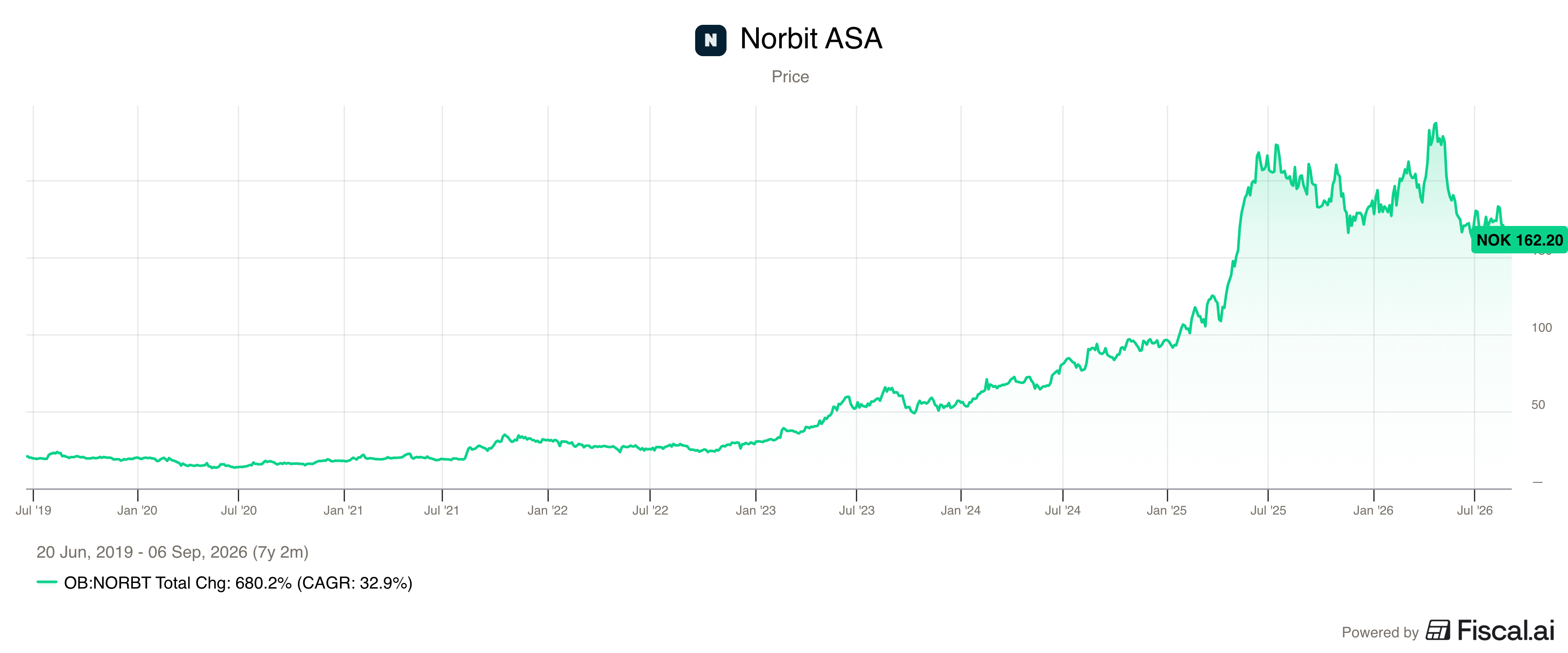
Thus, we ask ourselves, could 160 NOK be another buying opportunity into one of Norway’s fastest growing companies?
Disclaimer: This newsletter is provided for informational and educational purposes only. The views expressed are my own and do not constitute financial advice or recommendations to buy or sell any securities. The author may own shares in the equities discussed.
At first glance, you would not expect Norbit to be special. It looks like the kind of industrial business that should compete on cost: it manufactures physical products, operates relatively small factories in rural Norway, and historically served relatively niche markets. Most well known for their toll-tags, used in car and truck windscreens.
But a look closer, and the economics tell a very different story.
5-year revenue CAGR of 35%, EBIT margins of 21% and ROCE above 30%. None of those numbers you would expect from an average company.
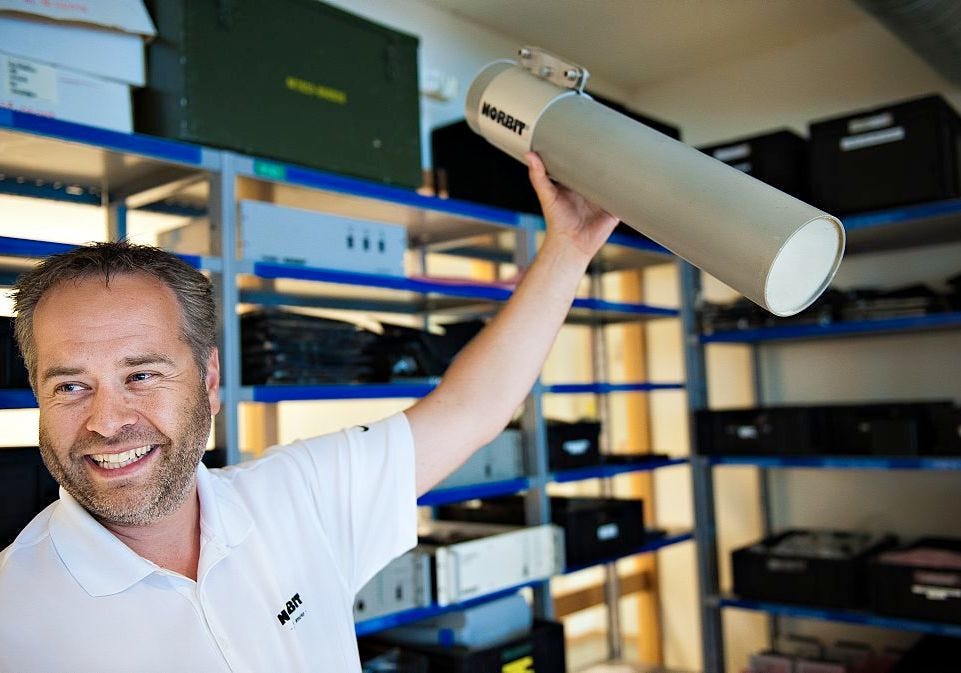
We think the best way to view Norbit is a niche industrial technology company, making technologically complex products — and, in some cases, the software required to operate them. Across its three segments, EBIT margins are unusually high, and even in its contract manufacturing segment — Product Innovation & Realization (PIR) — EBIT margins are now 21%. Notably, those margins have been significantly lower in the past, so a reasonable question to ask is whether the business mix there is extremely favourable now, and margins will revert back to the mean. We’re still not sure what PIR margins should be longer term, but would not have guessed them to reach 21% a few years back.
Norbit’s business model is mostly low-volume, high-mix, but Norbit have benefitted from higher utilization of their factories from increased scale in recent years. Especially within their contract-manufacturing segment PIR, where they’ve been able to replace more low-margin auto customer parts into higher-margin defence products.
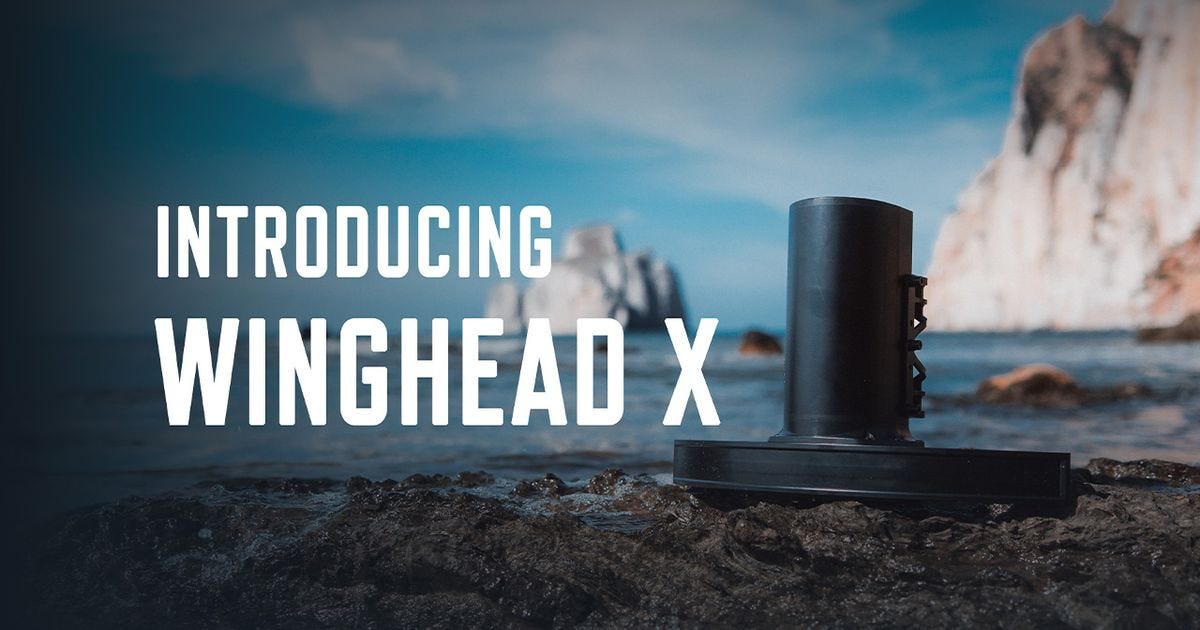
To get a sense for the type of products Norbit sell, consider that in their Ocean business they make purpose-built camera solutions for 7 different end-markets to map the ocean, like subsea construction, hydrographic surveying or intruder detection. A famous one being the Norbit Winghead, used to map the seabed.
In their Connectivity segment, one example of a typical Norbit product enables tracking of truck drivers, plus the automation of toll invoicing across border-crossing. This is enabled by allowing one single product to work with different road-monitoring technologies. Their Toll4Europe partnership is a testament to their ability to deliver.
We view Norbit like a niche industrial technology company, making specialized products for niche end-markets. A giant like Huawei wouldn’t bother to compete.
And perhaps the single biggest lesson from following Norbit for many years now — they are making increasingly complex and valuable products over time.

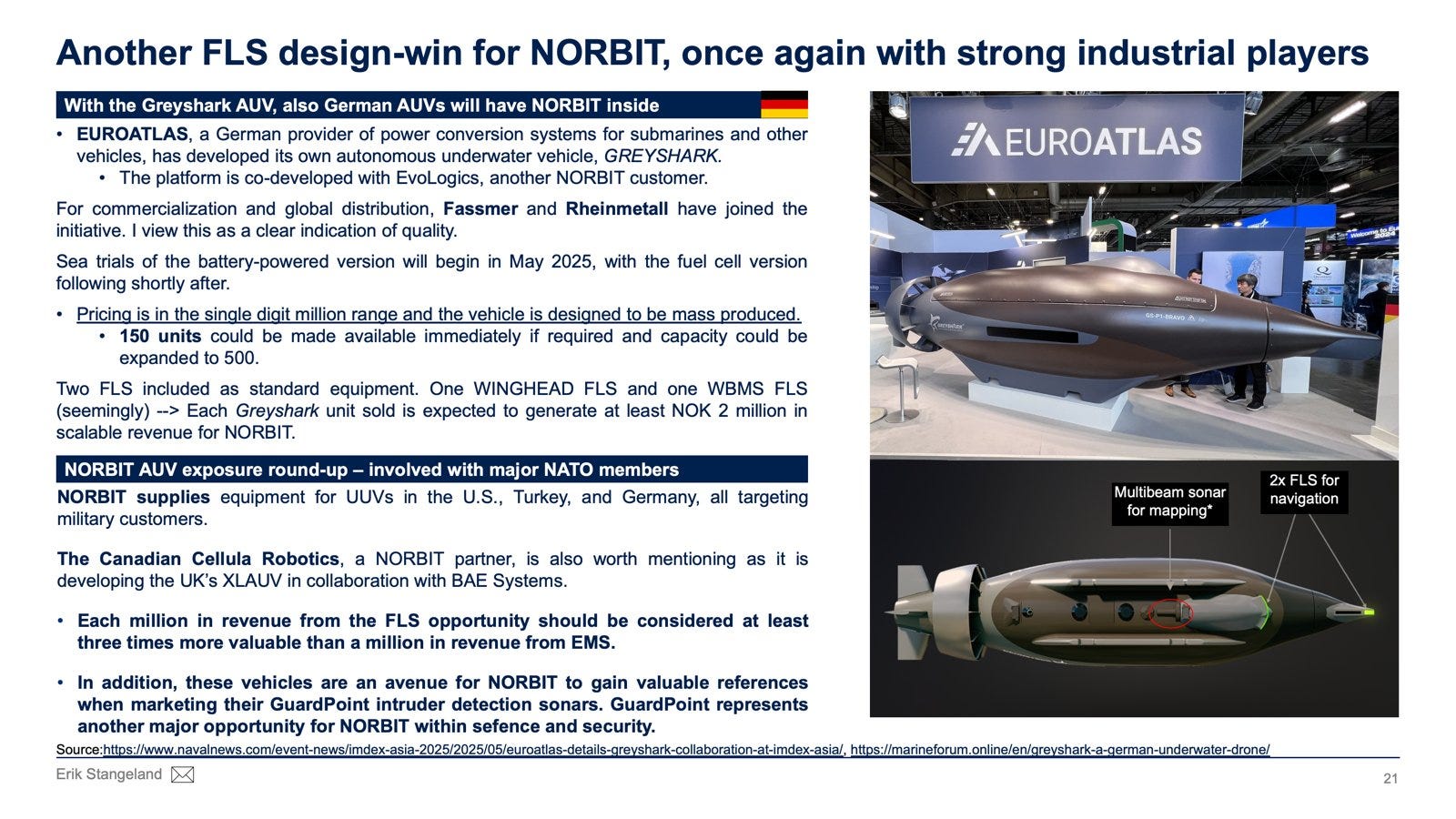
Erikstangeland on X have previously shared details on how Norbit’s Ocean products are increasingly seen on automated underwater drones — mission-critical parts within an industry experiencing explosive growth. So it’s not just Norbit’s PIR segment benefiting from defence exposure — also the Ocean segment.
A bear thesis for Norbit longer term would be that as they grow into larger end-markets, they face increasing competition, leading to lower margins and returns on capital. Competition
If you grow at more than 20% for a long time, you will ultimately face larger and more well capitalized competitors. This have been in the back of our mind for several years. Another problem would be that the organic growth opportunities will dry up, and you will have to enter new verticals, which typically come with upfront investments and very uncertain return characteristics. That’s why many of the largest diversified industrial companies have excelled by deploying an acquisition-model, where they can buy things that are already working.
The American giant Ametek is such a company, which we covered in our 2024 Nordic Industrial writeup. They acquired their way into more niches, instead of organically seeking larger and more competetive end-markets. The results have been an incredible compounding journey for shareholders.
But, Ametek is 50x larger than what Norbit is today, but we think there are a few similarities. The most notable is that Norbit is slowly building an acquisition track-record for themselves. Mathias - LTG broke down Norbit’s past acquisition well here.
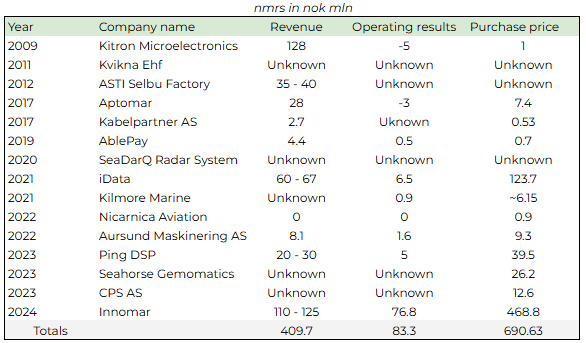
Mathias also broke down some criteria’s Norbit look for:
Accretive to Earnings (CEO later also mentioned not dilutive to overall margins, which limits the acquisition pool drastically given Norbit’s high margins).
Match Norbit’s Culture. Mathias also highlighted an example where Norbit and Innomar employees meet together to develop new products together.
Preferably less than 10% of Norbit’s size. The 2026 acquisition of Water Linked (not in picture above) was 3% of Norbit’s 2026 sales.
We think the interesting observation with Norbit is:
Their acquisition-track record builds confidence in their growth runway outside organic opportunities.
Their organic opportunities seem very strong, with ambition for 19% organic CAGR until 2030 expressed by management.
Their historical returns on incremental capital remain excellent, and management is building a track-record of strong capital deployment.
The comparison to Ametek become more striking when we put some numbers behind it. We think it clearly illustrates why investing in smaller ponds can be an advantage.
Return on Capital Employed (ROCE): Norbit 31% vs Ametek 15%
Revenue CAGR since 2019: Norbit 23% vs Ametek 7%
EBIT margins LTM: Norbit 22% vs Ametek 26%
Forward EV / EBITDA: Norbit 11x vs Ametek 19x
Ultimately, the result from these figures is that Norbit requires less debt and can pay out more profits to dividends — both great side effects of running a highly capital efficient model.
Key reasons for the higher ROCE of Norbit is higher organic growth plus Ametek’s acquisiton-driven model typically involving competetive auction bidding. This usually inflates acquisition prices and lower returns on incremental capital, versus when Norbit acquires at a fraction of Ametek’s usual deal size. The model can still work for the larger Ametek, but if a smaller company can deploy a similar model at lower acquisition multiples, the compounding wheel simply fly faster.
That said, we don’t see Norbit like a serial acquirer. That typically involves several deals per year. Instead, we see it as another opportunity, and something that could in a optimistic scenario involve a higher terminal multiple for Norbit stock, given increased confidence in Norbit’s growth runway.
And with the market pricing Norbit at close to half Ametek’s EV / EBITDA, it seems like the market could be underappreciating Norbit’s quality and growth runway.

Norbit’s financials literally tell us that they have an edge. But to understand what that edge really is, we need to look beyond the numbers. Norbit has demonstrated an ability to invest counter-cyclically and make unpopular decisions when the market disagrees. And more importantly, have been proven wrong later. In that sense, we believe Norbit shares many of the “outsider” traits that William Thorndike describes.
Norbit — an Outsider
Norbit is an unusual company.
The first example that comes to mind is its decision to manufacture in Norway. The conventional playbook for European industrial companies a decade ago would be to outsource production to a low-cost country in Asia. Instead, Norbit with it’s headquarter located in Trondheim, doubled down on local manufacturing — including two key manufacturing sites in Røros and Selbu. Both small rural communities far removed from the traditional centres of European industry. Røros is best known as a mountain tourist town, while Selbu is even smaller with just 4,000 inhabitants.
It is a strange place to build a global technology company from. Yet, what once looked like a cost disadvantage is increasingly proving to be an advantage. With local municipalities strongly backing them, and with access to the engineering talent coming from NTNU Trondheim (Norway’s largest university), Norbit seem to have grown from local roots into a global niche technology leader.
Additionally, as geopolitical tensions have risen, trusted and resilient supply chains have become more valuable, particularly to defence customers. For these customers, “Made in Norway” is not just a cost consideration; it serves a competitive advantage.
The ownership structure is equally unusual.
CEO Per Jørgen Weisethaunet owns around 11% of the company, alongside several other insiders with meaningful stakes. Reitan Capital owns around 10%, has a board seat and represents another significant long-term shareholder. Founder Steffen Kirknes recently retired after being one of only two CEOs in Norbit’s history.
The result is a long-term oriented shareholder base run by owner operators.
Norbit’s communication is similarly unusually honest. Weisethaunet has openly acknowledged that he does not know where Norbit’s future growth will come from.
While Norbit just published another ambitious five-year growth outlook, they avoid presenting a precise roadmap. The philosophy appears to be to build a capable organisation, remain financially disciplined and be ready to pursue attractive opportunities when they emerge.
So far, Norbit’s approach has produced impressive results, like you can see below.
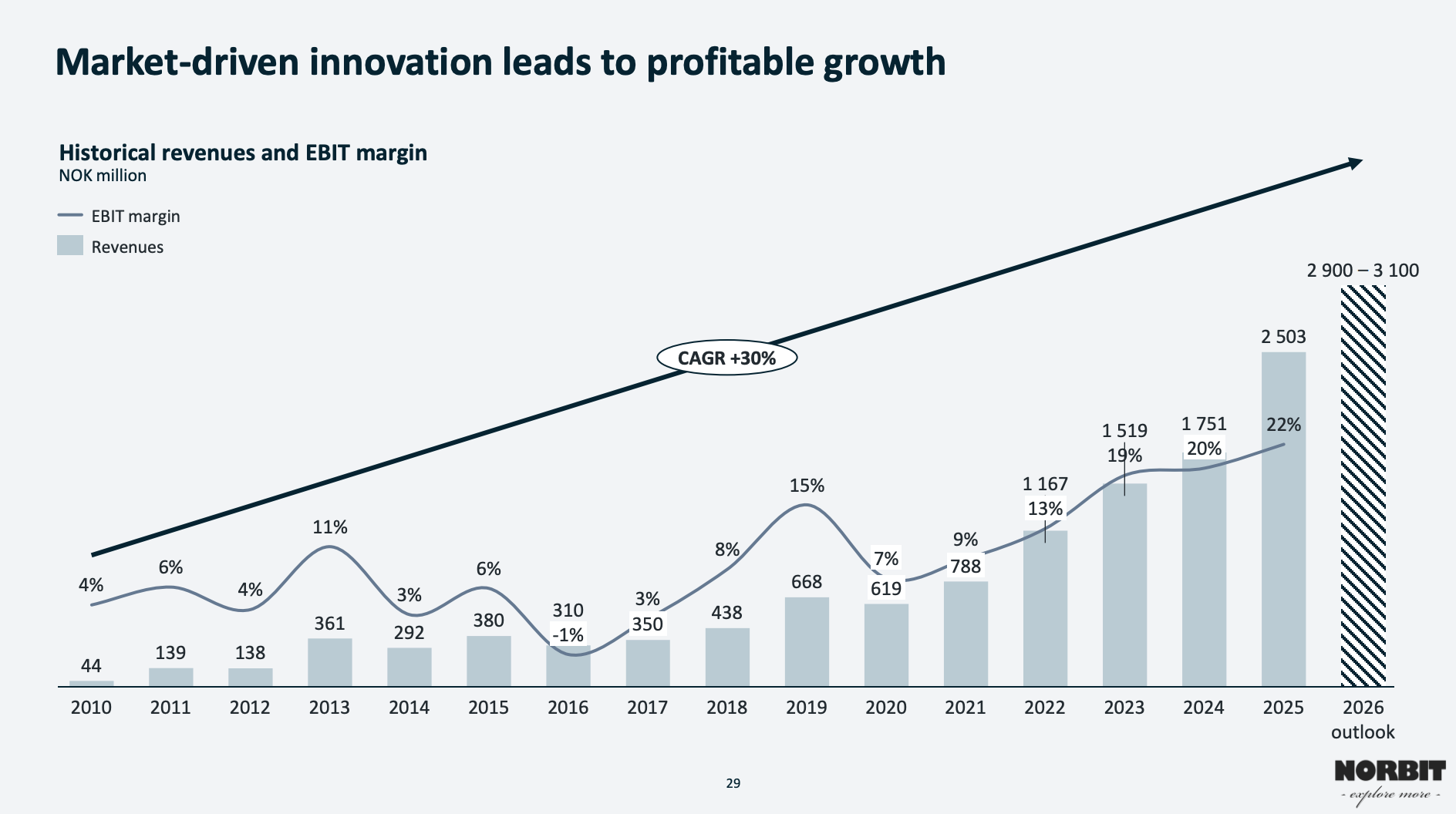
The most unusual thing about Norbit may simply be it’s margins. Where industrial market darlings like Tomra (usually >2x the valuation multiple of Norbit) have long struggled to reach double-digit EBIT margins, Norbit have even surpassed 20% in it’s contract-manufacturing segment (PIR). And within their proprietary product segments, Ocean and Connectivity, EBIT margins are closer to 25-30% (!).
We think a key reason for the exceptional margins is having a frugal culture.
One of our favourite anecdotes from Weisethaunet is his story in an earnings call where he shared how he and his wife considered upgrading a cheese slicer at home — when asked about his new status as a billionaire. It is a trivial example, but it offers a glimpse into a culture where unnecessary spending is questioned.
This culture is also reflected in where Norbit chooses to compete. Rather than pursuing enormous addressable markets, the company has built leadership positions in a collection of narrow, technically demanding niches.
The bear case here, would be that margins are cyclically high. It’s a risk worth paying attention to, given that margins where nothing like today a few years back. The counter-argument would be that these margins is a result of the larger scale and complexity they solve for. For instance, the on-board-units (OBU) Norbit is so well known for within Norwegian windscreens, is not their main product anymore.
Where OBU’s represented a third of sales in 2015, it’s just 6% of sales today. Even within their Connectivity segment, you can see the much more rapid growth within other segment, primarily Satelite-based tolling.
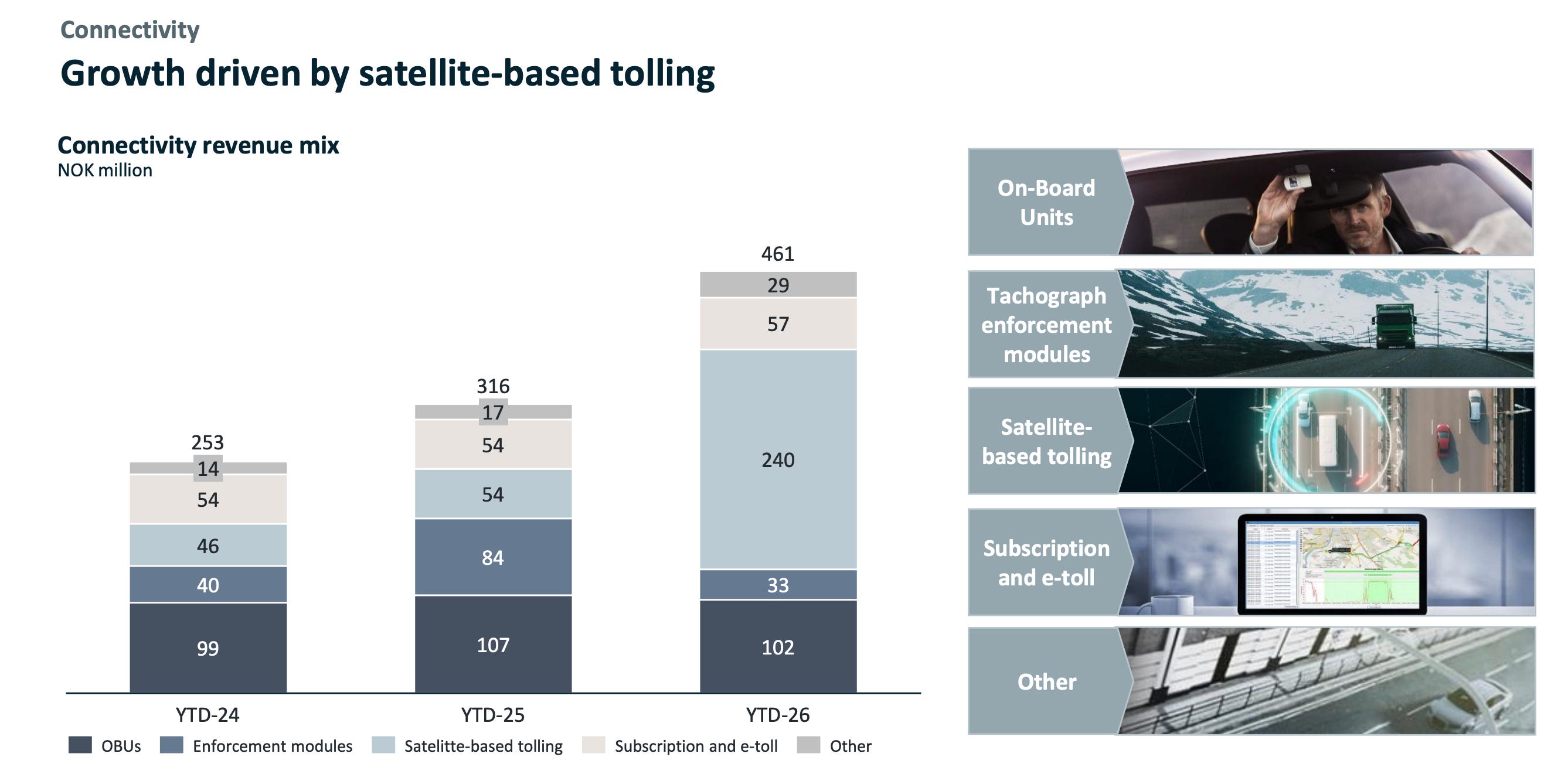
Some investors may be worried seeing the fluctuation between segments. But Norbit’s advantage is that they can shift production capacity to the products in highest demand. Resulting in reduced cyclicality for the broader group.
Back to the overall picture. It would be an understatement to say the 3 segments have been executing well for the last years. Looking back just 5 years, and you would see a completely different product portfolio, much smaller customer segment, with products within Ocean tilted more towards ocean surveying, Connectivity more towards Norwegian consumer tolling and PIR with low-margin contract manufacturing.
Fast forward to today, and all 3 segments have expanded meaningfully. Just within the Ocean segment, you will find the amounts of niches they’ve expanded into having increased drastically — also benefiting from trends like automation.
To illustrate the tailwind of automation — consider that 20 autonomous drones replacing 1 large vessel, will each require their own sensors and camera’s.
Within Connectivity, the more well known windscreen toll chip in Norwegian cars have gotten a less meaningful revenue drivers vs the truck connectivity solutions they create today. By handling the complexity of all the different toll solutions across Europe, Norbit is suddenly an enabler of less invoicing, more seamless border crossing and better control of truck drivers driving times etc.
Norbit has also benefited from rising defence demand — and not just through its underwater drones and other products within the Ocean segment.
The effect is even more interesting in its contract manufacturing business, Product Innovation & Realization (PIR), where the client base has increasingly shifted towards defence customers. This segment generated an astounding 21% EBIT margin over the last year — despite not selling proprietary products.
The explanation is likely that Norbit combines engineering capability with manufacturing expertise to produce complex, low-volume products. Its defence customers are effectively outsourcing part of the product-development and manufacturing challenge to a trusted partner.
And this is where the different pieces adds to Norbit’s moat.
In-house local manufacturing leads to quick feedback cycle from headquarters to manufacturing locations nearby.
Contract manufacturing with R&D capabilities exposes Norbit to innovations outside their own product portfolio — creating a pressure to stay updated.
High insider ownership and stable shareholder base create long-term alignment.
Close ties to engineering talent support technical expertise.
A willingness to focus on narrow, demanding markets allows Norbit to compete on expertise rather than scale. Add cost discipline, and margins remain high.
Acquired companies like Ping DSP and Innomar have operated decentrally after close, with their own name + “a Norbit company” below their logo. This means Norbit employ a similar autonomous formula succesfull to industrial acquirers.
None of these characteristics would be remarkable on its own. Manufacturing in Norway could be a disadvantage. Rural factories could be inefficient. Niche markets could limit the company’s ability to grow.
But together, they form parts of Norbit’s competetive advantage, allowing them to earn 20%+ operating margins and even higher returns on invested capital.
Additionally, the path Norbit’s on is just as interesting. For every year we’ve followed Norbit, we’ve seen them expand into more niches and more complex products. A perfect illustration of them following their own mission - Explore more.

Financial Goals 2030
Norbit just entered it’s fourth strategic period — with the previous 3 having been very succesfull. For Norbit, this involves ambitious goals centered around exploring more. Over the years, these are the characteristics that served Norbit well in the past.
Each of the 3 segments (Ocean, Connectivity and PIR) benefits from strong underlying trends, technological innovation and increasing customer demand.
Structural trends involve digitalisation, autonomy, electrification, sustainability, geopolitical unrest, resilient infrastructure and the increased demand for advanced sensing equipment. The latter being worthy of an extra thought.
If the real world is getting increasingly digital and autonomous, there’s no way around sensing equipment. Norbit have already established them as a leader in this space, within their respective niches. And given that Norbit is just a $1 billion company, there’s plenty of whitespace to leverage their 30+ years of expertise within such fields.
Norbit’s ambition for 2030 is to deliver organic revenues of ~ 6 bn NOK, an EBIT margin of 20-25% and ROCE greater than 30%. With the last to already being proven, there may not be much operating leverage left. Thus, topline growth is expected to be the main driver of value creation for Norbit going forward.
This goal implies a 19% CAGR over the next 4 years, just organically.
Over the last decade, Norbit stock delivered a 36% CAGR to shareholders. This was explained by having 4 simultaneous value drivers: Rapid growth, margin expansion, working capital efficiencies (NWC to sales down) and multiple expansion for it’s stock.
Going forward, margin expansion is less likely to contribute as materially, given it’s high starting level. Working capital efficiencies, which leads to higher free cashflow conversion, is harder to judge how much leverage management have left to flex out. It’s no surprise topline growth should remain a priority for management, given their exceptional value creation ability proven to date.
On top of this 19% organic growth target, Norbit also look for acquisition opportunities that expand market opportunities and are value creative.
Most notable is perhaps that CEO Per Jørgen have several times stated they’re not looking for companies diluting their overall financials. That wouldn’t be such a dramatic statement for most companies, but when you’re already a 20%+ grower, with 20%+ operating margins and 30%+ ROCE, you wouldn’t assume there’s that much to choose from.
Nonetheless, Norbit pulled such a rabit out of the hat in June 2026, with the purchase of Water Linked, a Trondheim based company (close to Norbit’s HQ).
Water Linked Acquisition
Water Linked is expected to generate 100 million NOK in sales in 2026 (3,3% contribution to Norbit) with 25-30% EBITDA margins. We’ll leave some highlights from both Norbit and Waterlink’s management of their thoughts behind this deal for those interested.

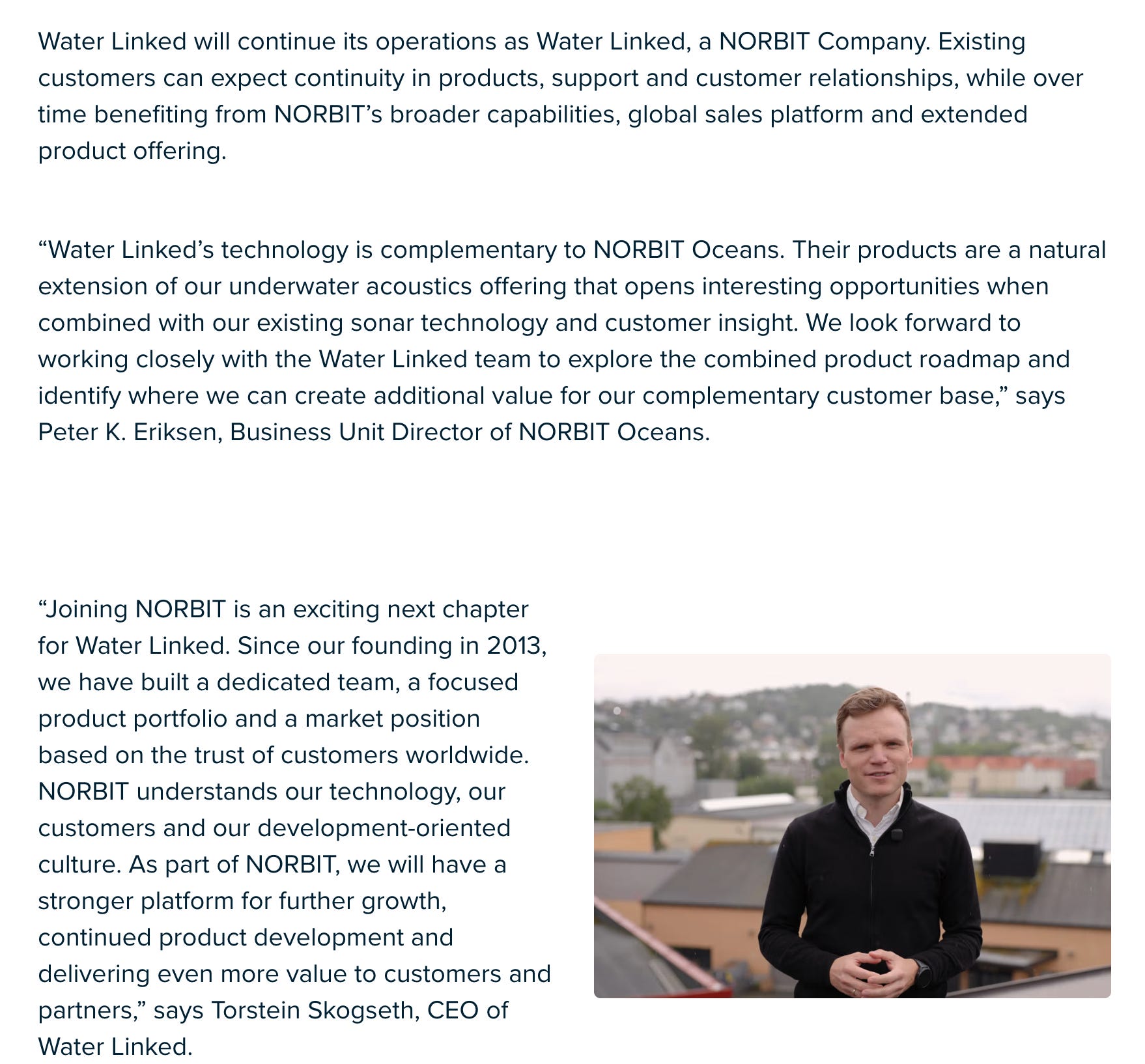
Perhaps most notable here, is that Norbit and Water Linked plans to explore a combined product roadmap and collaborate closely. We remember similar discussion of potential synergies from the Innomar acquisition in 2024, but more focused on having a joint sales team to cross-sell their respective products to customers they had close ties with already.
Whether there will be any synergies realized remains to be seen.
The purchase price of 330 million NOK, meant roughly an 11x EV / EBITDA multiple for Water Linked. While Norbit’s own stock doesn’t trade at a material premium to this at 12x, it’s worthwhile considering that Water Linked is still considered a fast grower. Below, you can see Water Linked’s revenues since 2013. From zero to …
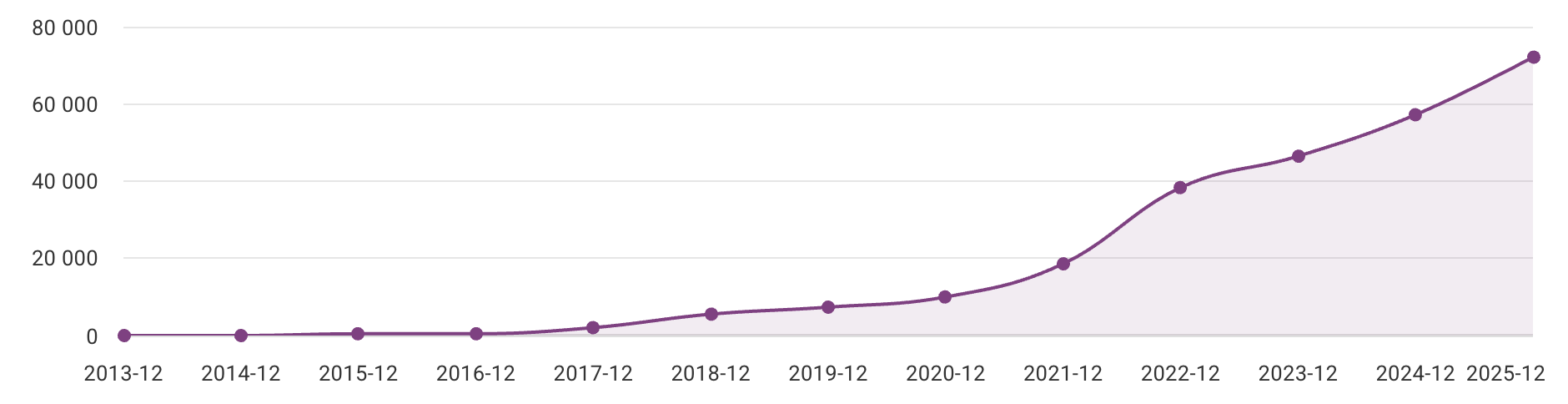
While the return on capital from this deal requires continued excellence to yield good returns, it’s a deal which seem to suit Norbit very well. We’re well aware that many investors are skeptical of this deal in particular, but we think Norbit deserves the benefit of the doubt when it comes to acquisitions given their track-record. That could obviously change in the future, but for now, we haven’t seen much reason to remain skeptical of their ability to create value from their investments.
Valuation
Before valuing a company, we first prefer to go over their past reinvestments. If incremental returns on capital are poor, a company should arguably pay out most of their profits as cash.
The remaining part of this writeup will be exclusive for paid subscribers.