

Most of our holdings have now reported H1 2026 results. As usual, the reports triggered significant share-price volatility: Harvia +13%, Shift4 -10%, Adyen +15%, and CSU -7%. Most of these moves largely reversed over the following days. The outlier was Adyen, which is now up roughly 30% since our writeup just 2 months back.

Shift4 saw the most extreme volatility, falling from $55 to $40 before recovering to $48. But again, the fundamentals developed relatively stable. If we hadn’t known these stock price reactions, we’d just assume it’s business as usual for most of these.
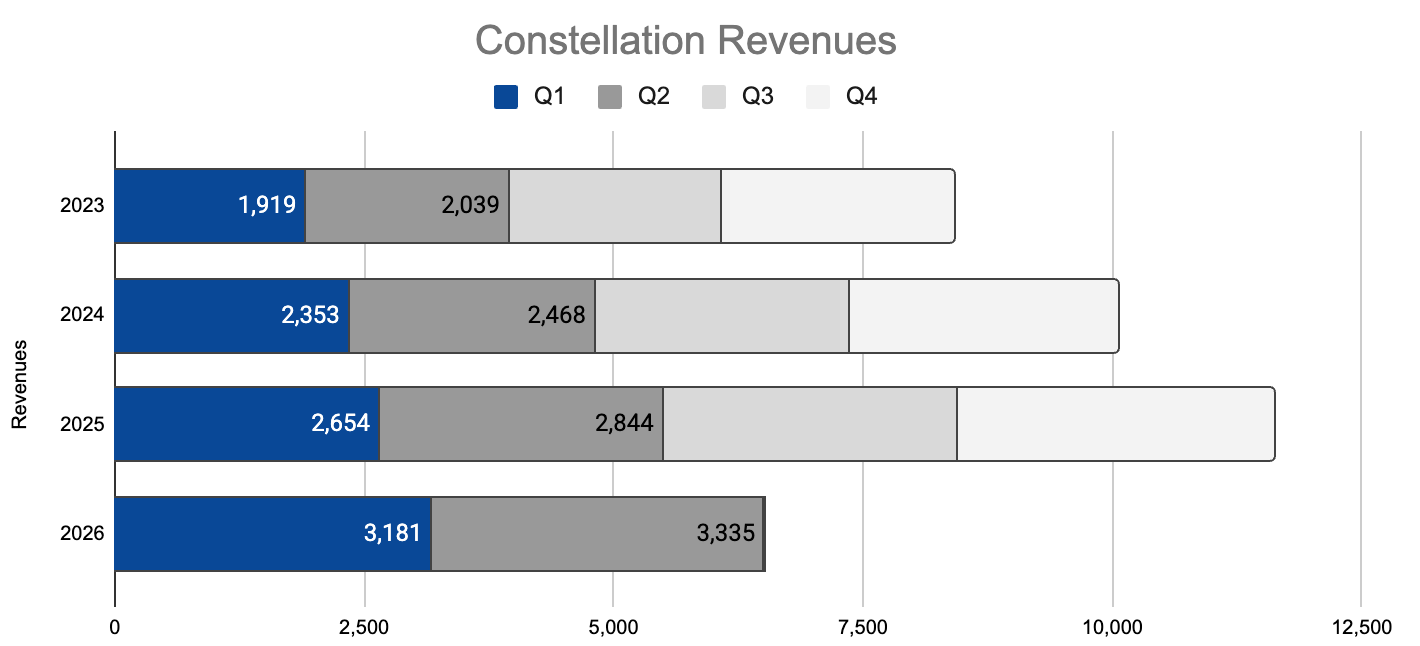
One of those was Constellation Software, who’s growth still look closer to what you’d expect from a bond. But with a key difference, it still compounds at 20%.
In the summaries below, we recommend you to scroll down to the companies you find interest in. Thanks for following along!
Cheers, Ole
Disclaimer: This newsletter is provided for informational and educational purposes only. The views expressed are my own and do not constitute financial advice or recommendations to buy or sell any securities. The author may own shares in the equities discussed.
Constellation Software & Topicus
AI has been a clear overhang for Constellation and Topicus’ share prices. While this risk receive most attention for now, we think another factor we see few mention is a potential complexity discount as they scale. Especially with their PEMS strategy of buying stakes in publicly listed equities, like Topicus did with Asseco Poland last year.
It’s already quite complex valuing Constellation and Topicus. And in our opinion, even more so for Asseco Poland. It seems investors in Asseco Poland value it using a P/E basis, which takes into account the proportional ownership of their different earning streams. But, the trailing P/E can be misleading for acquisitive companies, as they amortize the acquired intangibles relatively quickly, despite little signs of detoriation within the software business (like a machine typically would when being depreciated).
If investors where to value Constellation and Topicus on a P/E basis, they would likely underappreciate the earnings power from these software consolidators.
The Net Income line also consist of other type of noise, like reported changes in market value. But even a topline figure, like organic growth for Constellation Software, is being distorted by them acquiring Alterra a few years back. Alterra is a “melting icecube” with volatile contracts, something impacting Q2 numbers this and last year in particular. Over time, this should equal out and the underlying ROIIC on invested capital shines through (even if buying a declining asset), but our point remains: It’s getting increasingly complex tracking the progress of Constellation.
Nevertheless, we don’t worry about this complexity.
If this was a “NAV discount closing” or “PE multiple expanding” thesis, their stocks likely would need a trigger for that rerating to occur. But, with Constellation and Topicus, fundamentals are luckily still compounding at 15-20% annually, meaning you don’t need an upward rerating from today’s ~20x multiples for the stock to work.
For other complex Holding Companies, a big discount makes buybacks an attractive lever for management to pull, but here Constellation and Topicus seem to continue finding even better opportunities to deploy capital towards than their own stock.
The fact that none of them have increased capital returns from the very modest levels (higher for Asseco), is a sign they still see reinvestment opportunities. Topicus’ net debt levels are perhaps the most notable having fallen from €366 to €144 million over the last year. That signals optionality going forward. Constellation assigning just 5% of NOPAT to dividends is another positive sign.
An interesting observation when it comes to a complexity discount, is that the market assigned a massive premium to Topicus’ market value last year, after their investment in the listed company Asseco Poland quickly doubled in value. Which ironically, made the company much more complex to analyze.
However, when the market see clear signs of excellence in capital allocation, they tend to take notice. And, with a very succesfull Sygnity deal in the past too, it could be that the market assign a premium to these entities over time, as their track-record grows, both buying private and perhaps increasingly so, listed businesses.
We have started seeing something similar to another Holding Company in Investor AB. Investors seem to, for the first time in a decade, have decided to place a NAV premium on the conglomerate. This despite investors being able to buy 80% of their assets on the public market themselves.
On the other hand, when it comes to Topicus and Constellation, most of their holdings and investments are impossible to replicate for us. And with their track-record, we would argue a bear case for Constellation and Topicus warrants some type of capital allocation premium multiple. In our models below, that’s a 22 and 23x EV / NOPAT in 5 years time. That could definitely be higher in our opinion.
Coming back to their 2026 performance, the big story is not yet about complexity or AI, but Capital Deployment. RBC capital estimate Constellation will spend $3 billion on acquisitions this year, which would represent roughly 110% of our estimate for NOPAT this year. That means Constellation enjoys another year of roughly 20% growth, given that these reinvestments continue to generate incremental returns close to 20% (see calculation of that figure below).
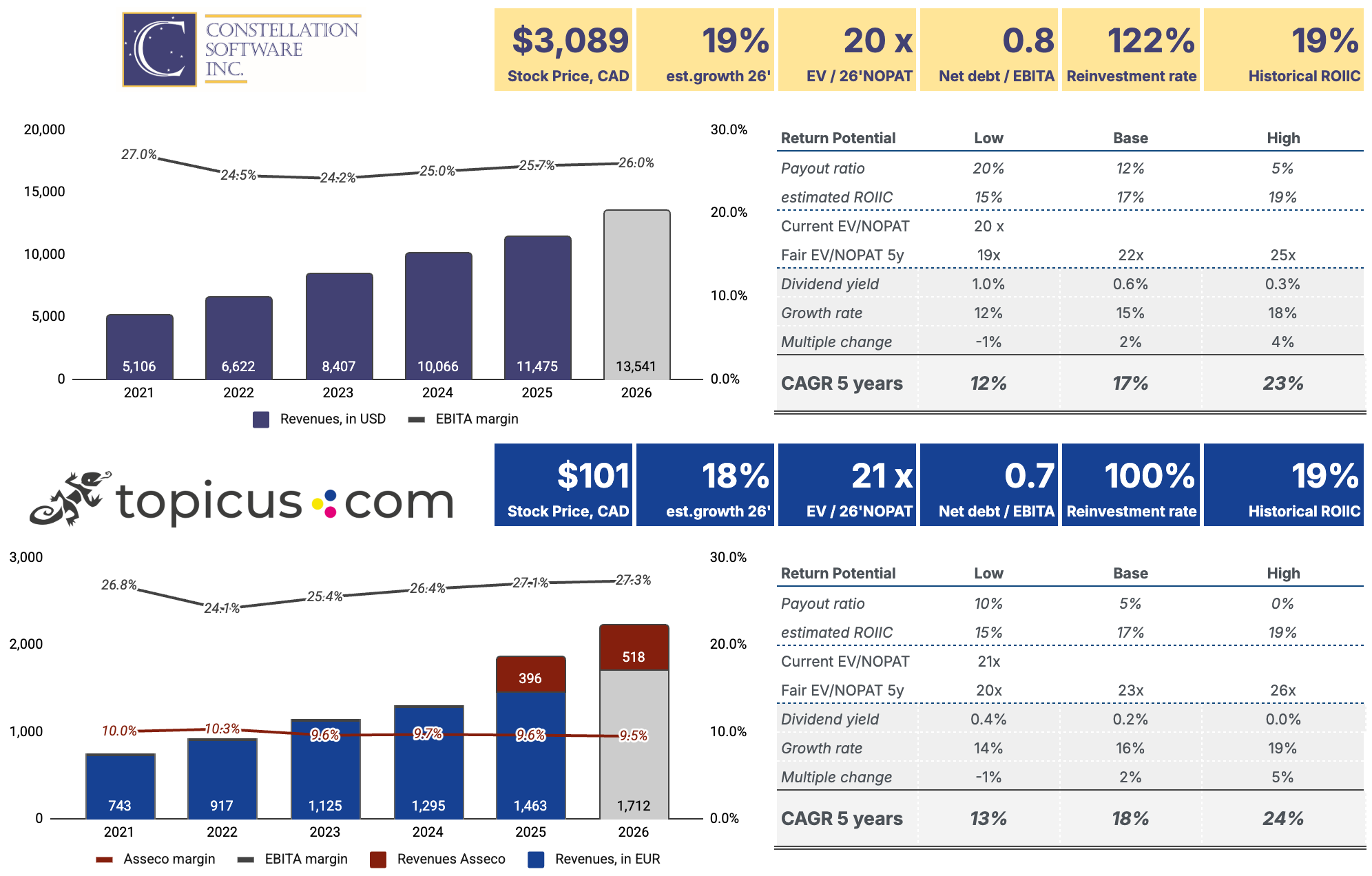
An underappreciated factor in Constellation’s model is high hurdle rates. By paying low prices relative to the cashflow streams they get (high ROIIC), the AI risk is reduced, simply by their ability to renew the business portfolio over time.
However, that scenario is not here yet. Organic growth is still positive — showing little signs of AI risk yet. Any small negative change in this number, like we noticed with Constellation this quarter, and the market is quick to take notice. However, the market have not yet reacted positively to the capital deployments this year.
We think the market misses the forest for the threes looking at the AI risk with Constellation. While it’s tempting to assume all software will die in the world of AI, reality is often somewhere in the middle. Some will struggle and some will prosper. And with Constellation’s more than 1,000 businesses, a number still growing rapidly, it’s easier for investors to paint a large brush over an extremely diversified portfolio.
For Topicus, Q2 saw 18% revenue growth with 4% organic growth. The increased organic growth within Topicus (especially maintenance growth) continue to impress, whereas Constellation Software has the steadier capital deployments. We like both and have equal weighings around 10% of our portfolio in each.
You can find link to the companies discussed below.


Adyen
Adyen reported H1 2026 figures with 21% constant currency growth and a slight EBITDA margin compression to 50% (53%).