Spiltan Invest
75-bagger on sale at a 33% NAV discount?

The other day I was looking for a fund for me and my family’s retirement account. I wanted some diversification outside the typical index funds, but struggled to find low-cost actively managed funds that owned equities I would be comfortable holding for the long term. A quick chat with ChatGPT about my investment style, and a fund called Spiltan Global Hold’co (translated) popped up. Top 5 positions being Berkshire, Constellation software, Markel, Fairfax Financial and Danaher.
Immediately, I recognised the name Spiltan, as its a well known holding company in Sweden, and a key owner of a previous holding of ours in Paradox.
But, looking at their 5y stock chart being down 25%, you would assume they’ve lost their touch. This poor stock performance over the last 5 years overshadow a very impressive compounding story. Since 1986, the shareprice have gone up from 2,5 SEK to today’s 185. A very impressive 11% CAGR over 40 years, and this even excludes dividends.
What went wrong over the last 5 years?
For every poorly performing stock, its a good idea trying to understand what the market is trying to tell us. The main reason for the poor performance over the last 5 years can be attributed back to the same factor that made shareprice performance exceptional over the preceeding 5 year period ending in 2021. Net Asset Value (NAV) pricing.
CEO in 2021: “The change in share price over the past year is largely attributable to the shift from a discount to NAV to a premium. Over the long term, however, it is always our ability to increase the value of our investments that ultimately determines share price performance.”
Holding companies trade relative to their net asset value, meaning both their asset values and the holdco’s relative pricing to this number can change. This adds another layer of volatility. But you could also say the NAV premium/discount is a pricing mechanism for the markets confidence in the holding company’s value creation potential longer term.
But for Spiltan, this NAV discount/premium have been unusually volatile. At the end of 2021, Spiltan traded at a 31% premium to NAV, creating a high hurdle for subsequent shareholder returns. Today, that premium has reversed into a 33% discount to NAV — close to historical trough levels of 36% (Ibindex).
Some could argue these changes in the asset pricing tells about the markets confidence in future value creation. And in 2021, the market was in a particularly good mood for many stocks, including Spiltan and several of their investments.
Below, you can see the development of Spiltan’s NAV, shareprice and index returns.
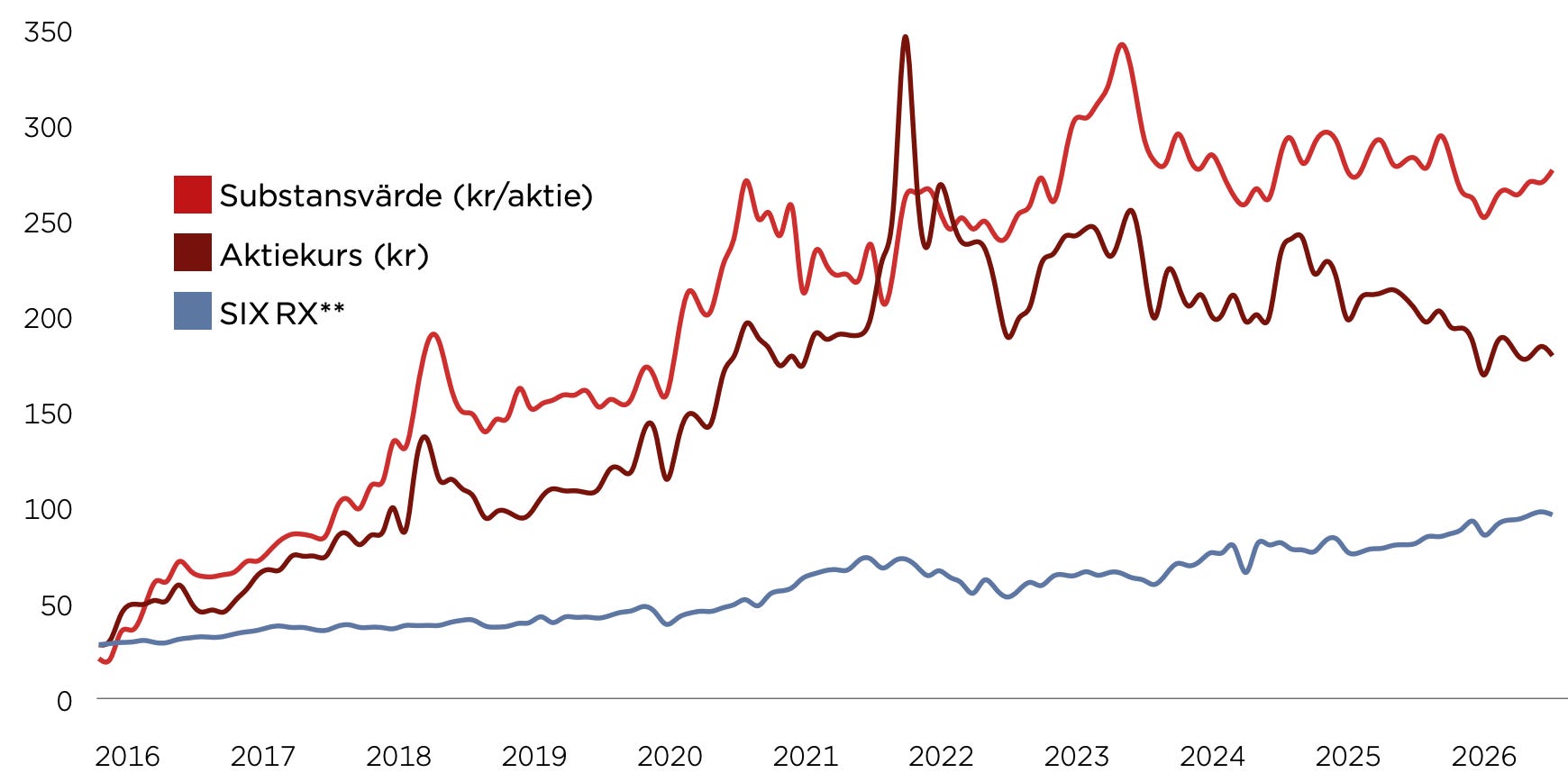
To put the impact into perspective: even if NAV had remained unchanged at 100, the share price would have fallen by approximately 49% purely as a result of the multiple contracting from a 31% premium to a 33% discount.
This is precisely where exceptional capital allocators can create value. Over the past couple of years, we have highlighted Eurofins, as a particularly good example: issuing shares when the stock was expensive and more recently, buying them back aggressively when they become cheap.
Spiltan did not take the opportunity to issue equity at elevated valuations in 2021. Today, however, they are actively buying back its own shares, taking advantage of the NAV discount.
But the second reason is just as importantly, NAV per share has stood still for 3 years. A key reason is that their main holding, Paradox Interactive, is currently in a 53% drawdown, also down 38% from the end of 2023. When your best idea fails, you also lose the faith of your investors it seems, explaining the current discount to NAV.
Fundamentals
When assessing Spiltan’s fundamentals, we view NAV as a useful starting point, but not the end of the analysis — similar to how we analyze Investor AB. Equally important is understanding what the underlying assets consist of, how they are valued, and, ultimately, what returns they are likely to generate going forward.
The distinction is important: buying a basket of overpriced assets at a discount does not necessarily make it an attractive investment. You may simply be buying a basket of assets that are themselves priced for disappointing future returns. Arguably, it’s far better to buy a basket at its fair price, if it contains great things inside it.
And by overpriced, we do not necessarily mean assets trading at high valuation multiples. Rather, we mean assets whose current valuations leave little room for satisfactory future returns. A low P/E can be just as expensive as a high P/E if the underlying assets cannot generate sufficient returns going forward.
And similarly to Investor AB, Spiltan’s income statement is mostly noise. We need to look one layer deeper to understand the true value creation under the hood.
Spiltan’s fundamentals
Luckily (in contrast to Investor AB), Spiltan break down their share of profits. In the Q3 2026 letter, CEO Per broke down his thoughts on their fundamentals vs pricing.
I have previously noted that Spiltan’s share of the profits generated by its portfolio companies (15% of Paradox, 90% of Spiltan Fonder, etc.) has increased over the past five years from SEK 350 million to SEK 540 million. This year, we believe this figure could increase further.
However, this also means that the market is valuing our earnings at a P/E ratio of 10, which I find puzzling given the number of excellent investments with high annual rates of return (IRRs) that we have made historically and continue to make.
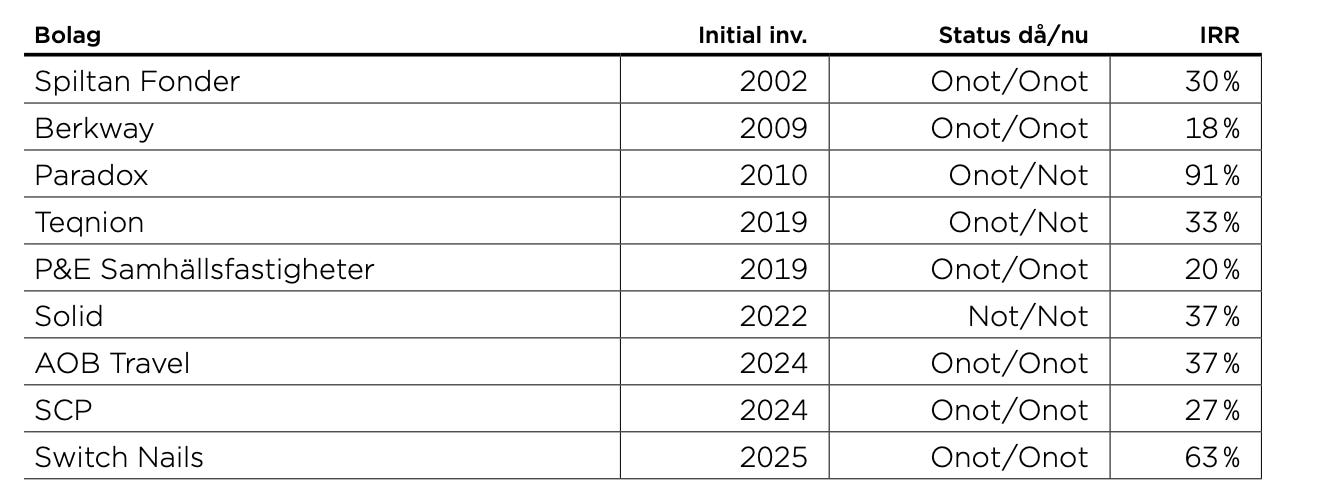
The table shows the IRRs for the companies that account for approximately SEK 5 billion of our portfolio, representing around 64% of our total net asset value (NAV).
If we add this 9% CAGR in underlying earnings (350→540) and divide by shares outstanding, which have declined by 1% annually, we end up with a telling graph.
The market has gone from pricing Spiltan at an underlying PE of 32 to 10x.
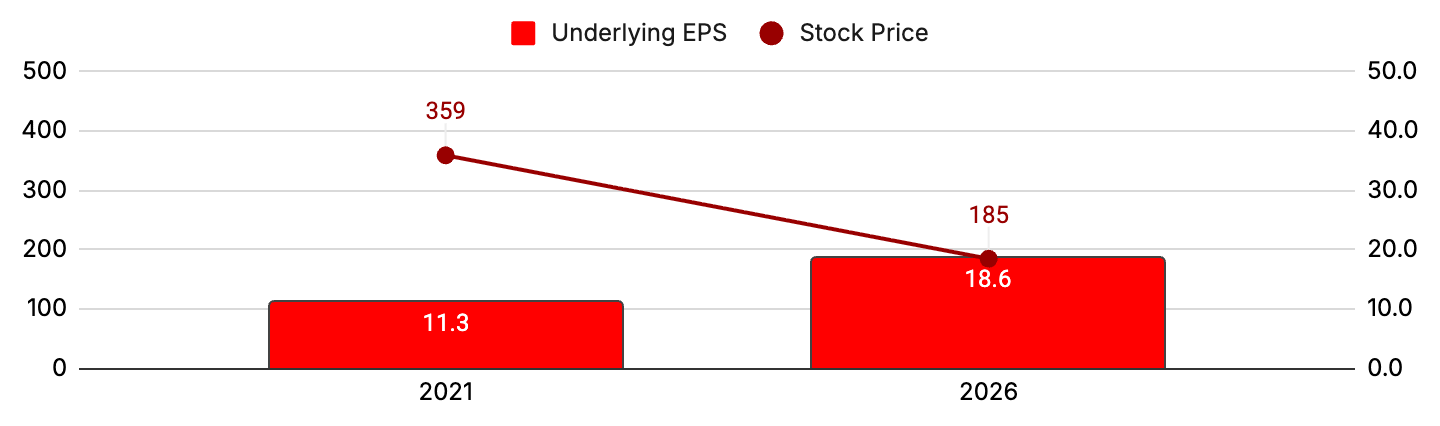
Our take is that an underlying PE ratio of 10x, suggest the market implies Spiltan’s holdings to be non-growers. The assymetry is that there’s little evidence of this.
Spiltan’s Portfolio
As 96% of Spiltan owners are Swedish, the documents are unfortunately not translated. We’ll do our best to cover the signal here.
From 2025, Paradox updated their breakdown of NAV, by making a distinct first category — larger holdings: including Paradox and Spiltan Fonder. An understandable choice, as these two reprecent 52% of NAV as of Q3 2026. The subsequent categories are serial acquirers, properties, other listed equities and cash.
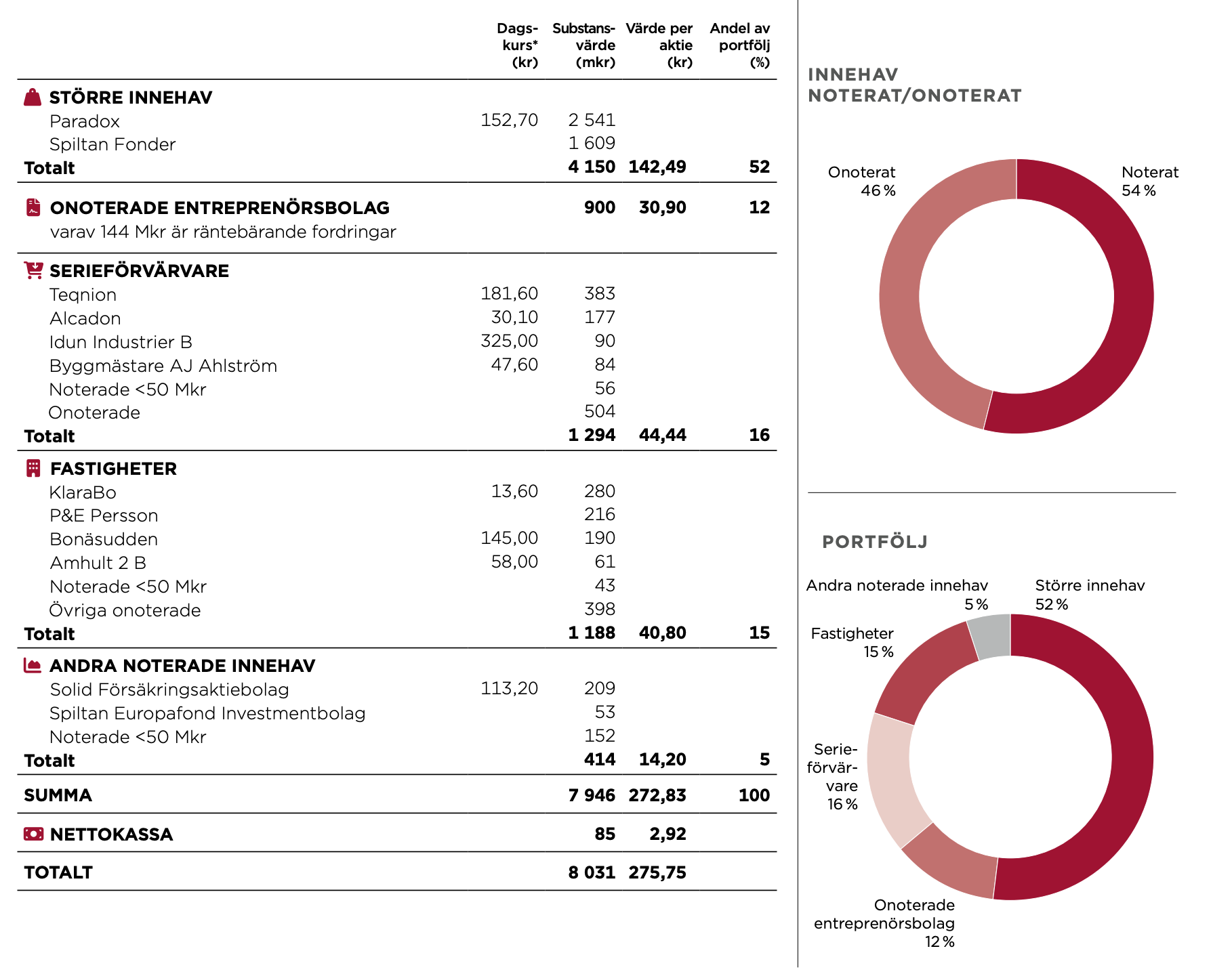
Concentration risk would be noticed by most here, and the CEO’s response is:
A large part of Spiltan’s historical success can be attributed to our two largest holdings: Spiltan Fonder and Paradox Interactive. Both investments have increased in value more than 100-fold and are known as “100-baggers”.
The companies have benefited from growth and further growth, expanding P/E multiples, and founders with significant ownership stakes. But most importantly, we have held these investments for a long time (since 2002 and 2010, respectively) and have sold none of our shares in Spiltan Fonder and only small portions of our holding in Paradox.
The most common mistake investors make is selling great companies too early.
And on the significant Paradox position in particular, which could help explain part of the NAV discount:
In summary, we recognised that having such a large proportion of the portfolio invested in a single company naturally entails risk, particularly given the inherent uncertainty of the future.
However, at Spiltan, we believe this risk is worth taking, as Paradox continues to have very strong long-term prospects.
Paradox Interactive (32% of NAV)
The investment thesis is built on the expectation that the gaming market grows by approximately 6% annually, combined with Paradox’s strong customer loyalty and highly durable gaming franchises. One of the industry’s biggest challenges has been developing successful new titles. For Paradox, however, technological advancements does not seem to be the primary selling point. Its games are differentiated by their genres, storytelling, depth and other gameplay elements.
The past decade has been volatile, with several new title releases between 2021 and 2024 failing to meet expectations. Following these setbacks, founder Fredrik Wester returned from retirement and refocused the company on its core franchises, helping steer it back on course.
Earlier this month, Wester stepped down as CEO to become Chairman, while remaining the company’s largest shareholder with a 34% stake. Spiltan is the second-largest shareholder with 16%, followed by Tencent with 10%.
You can find our two research pieces on Paradox Interactive below.


The key risk for Paradox is customer loyalty. The millions of Cities Skylines and Hearts of Iron players needs to be continoussly entertained. The fact that players can mod the games themselves for free and buy upgrade packs from Paradox, has served a good combination enabling game franchises that are played for decades.
The second largest position (and 100-bagger) is Spiltan Fonder. This tracks back to our hunt for a fund suited for our retirement account.
Spiltan Fonder (20% of NAV)
Spiltan’s fund business was founded in 2002 with 10 customers and 10 million SEK in assets under management (AUM). Today, they more than hundred thousand customers and more than 115 billion SEK in AUM. Up 11,500x over 24 years (from a very low base). It took Spiltan Fonder 7 years and 3 capital injections to reach profitability. Today, Spiltan Invest owns 89,4% of the highly profitable fund business.
The fund has had tremendous success with its European Hold’co funds, holding companies like Investor AB, Industrivärden, Lundberg og AstraZeneca, and, crushing most indexes over its lifetime with an 18% CAGR since 2011. Its small-cap funds have also delivered excellent performance by taking early stakes in companies like Indutrade, Lifco and other serial acquirers. Its global hold’co funds have also seen great returns, driven by the likes of Berkshire, Constellation and Fairfax Financial.
The common denominator has been a very consistent strategy — patient capital in companies that can reinvest capital at high rates of return. With a particular eye towards acquisitive business models.
And when you run a fund business with succesfull funds attracting more capital, its no wonder the business itself gets highly profitable as well. And the most exciting part, Spiltan Fonder still only has a 1% market share in Sweden!
Now we have covered the two main positions in Paradox and Spiltan Fonder. An investor in Spiltan should read up on these two investments in particular, as they’re so material to future NAV growth for Spiltan itself. The reminding 48% of NAV is equally important as these two positions, but these are much more diversified.
First out, we got the Serial Acquirers, a business type both Spiltan Fonder and Spiltan itself seem to particularly like. The Swedish market have fostered many success stories here.
Serial Acquirers (16% of NAV)
Of the 1,294 million SEK here, 500M of these are in privately owned companies. The main listed ones are Teqnion (383M), Alcadon (177M) and Idun Industrier (90M).
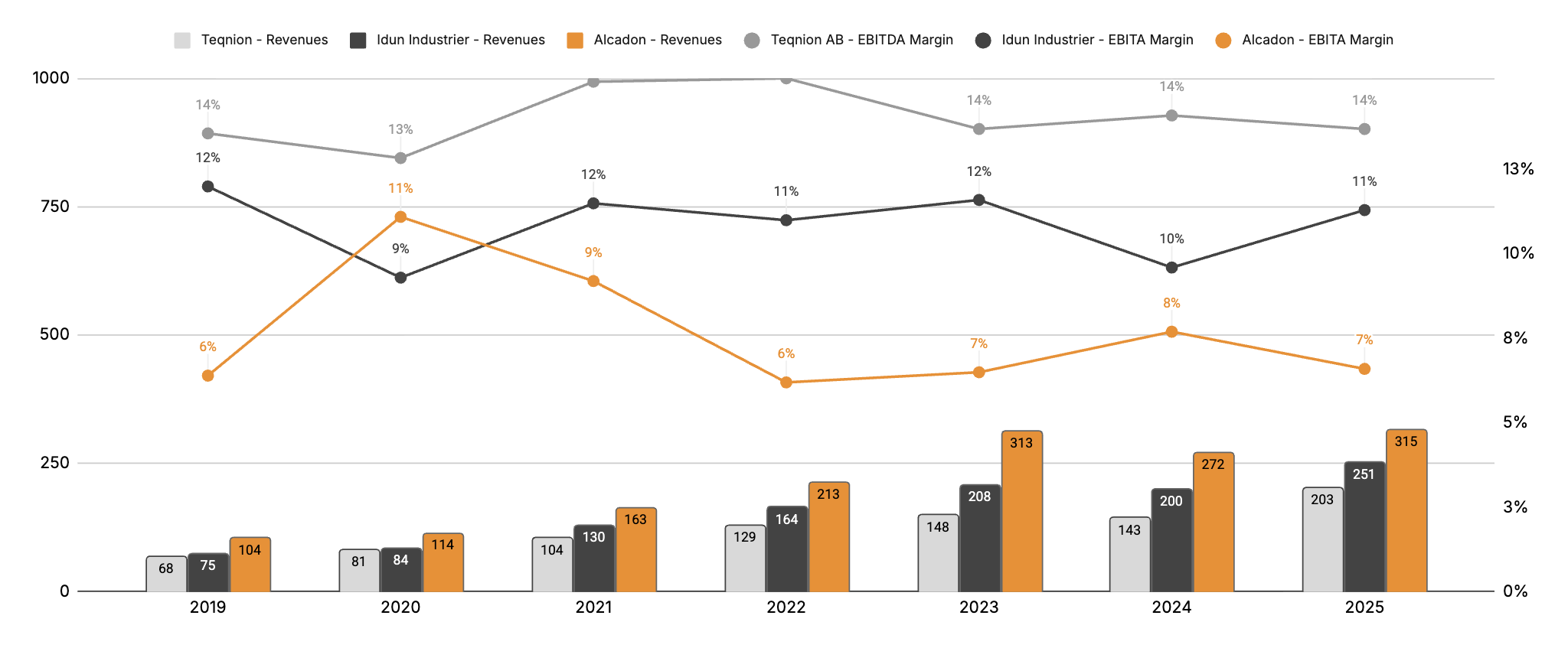
While all companies have reported strong growth, Alcadon, in orange, have struggled with margins, showing single-digit EBITA margins. But, since 2025, they have implemented and tracked EBITA to Working Capital, a key financial metric most of the succesfull Bergman & Beving family have tracked over time.
This transparent tracking of profitability is showing promising signs, with more of Alcadon’s companies in the yellow and green zone, with higher EBITA / WC metrics.
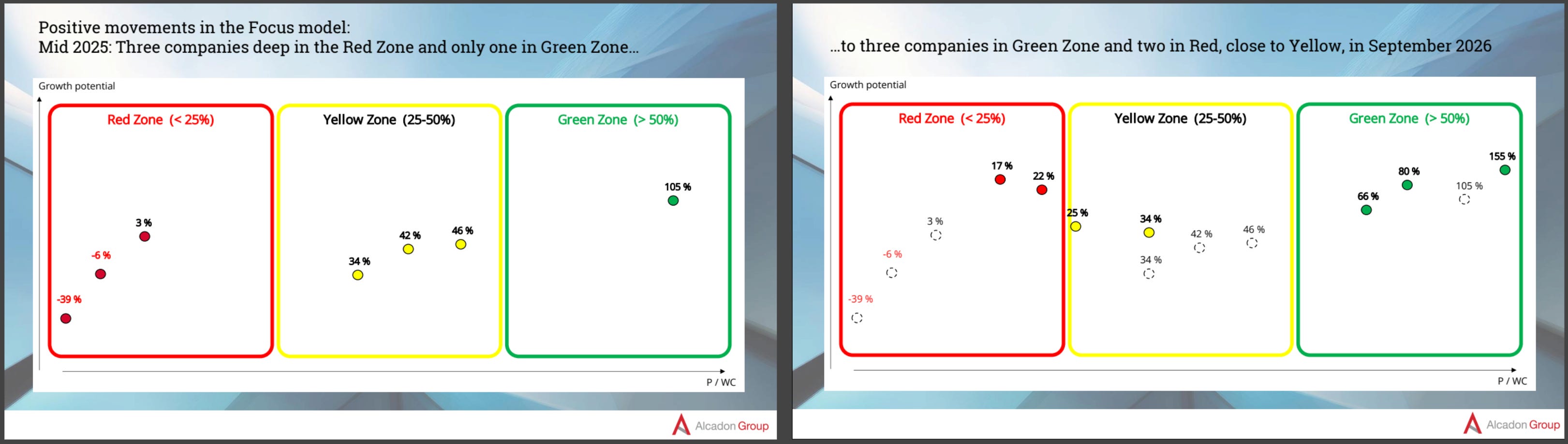
Profit to Working Capital on average is now 38% and Alcadon sees exciting opportunities in all their market segments, not only in data centers.
Teqnion, the largest individual holding here (5% of Spiltan’s NAV) have received renewed investor positivity, from their acquisition pipeline bringing in higher margin companies and doing some fixing in their underperforming early acquisitions.
These 3 listed serial acquirers share that they’re all very small ($6→45M market cap), which means they don’t need many deals per year to move the needle.
Real Estate (15% of NAV)
Perhaps the least exciting part at first glance, is the real estate portfolio. But Spiltan have seen good returns from this part of their portfolio over a long time horizon, at what they view as lower risk than equities. But they also had a very painful experience, selling their early investment in Förstaden, which turned out to become another 100-bagger. Management keeps calling out this mistake in their letters.
The market environment for real estate have however been poor over the last 5 years, with rising rates and building costs as a key reason. And with worsening market environments, market sentiment typically follows, and you can get a dual headwind for the stock. CEO Per calls this out in his 2025 Annual Letter below:
During and following 2022, however, rising interest rates and costs have resulted in several challenging years for property investments.
At Spiltan, we have historically made successful investments in real estate, and we believe that the outlook for the sector is once again looking favourable.
The main investments of their 1,2 billion real estate holdings are KlaraBo (280M), P&E Persson (216M) and Bonäsudden (190M). P&E Persson is wholly-owned, and was a classical succession solution, where Spiltan took over a generational change. The commonality among all real estate holdings is that they’re also small, just like the serial acquirers. These are typically $10 - 300M market caps, what would typically be categories as nano or microcaps.
Spiltan’s exposure to serial acquirers and real estate seems focused on smaller more agile companies. This basket likely serves Spiltan’s ambition to have another 100-bagger in their portfolio over time. Their turnover in holdings is relatively low, but they do add and sell holdings from time to time.
Rest of Portfolio (16% of NAV)
The reminder is invested in privately owned companies (900M, 11% of NAV) and other listed companies (414M, 5% of NAV).
One of these very succesfull unlisted recent investments have been Switch Nails. I asked my girlfriend about this, and she was already a customer. Switch Nails revenues have grown from 13M to 128M in just 2 years! And if that wasn’t impressive enough, they even delivered 20% operating margin for 2025 as well.
Coolstuff.se is another one, but with less success. The company’s sales have fallen by 50% since 2022 and is just about breakeven. But with investing, one success can pay for many losers. The table below shows Spiltan’s IRR on two third of its portfolio value today. Their portfolio have concentrated itself into its winners!
Capital Allocation
Its clear Spiltan employ an investment strategy of taking early stakes in many small companies, and allowing their few big winners to run, as long as they still see attractive long-term prospects.
The painful experience of Förstaden likely makes them reluctant to sell a holding even when trading at quite expensive prices, like Paradox have done several times in its past. Reluctance to trimming or selling comes with both positives and negatives. The positive is obvious, very few would have the ability to find 100-baggers, let alone hold them through the volatility their shareprice may reflect. And that patience is perhaps more important than optimizing the IRR at every point in time.
But this also means Spiltan’s strategy offer potential for increased volatility, as they can have both their individual holdings and their NAV pricing turn excuberrant without taking advantage of a good selling period. Most notably during 2021.
Paradox for instance have at multiple occations had 6 drawdowns of more than 50% in just the last decade. Holding through that type of volatility in your largest investment by far requires discipline.
We think the 9% CAGR in share of underlying profits is the key metric to watch.
We believe the best asset within Spiltan’s portfolio being Spiltan Fonder. The recurring revenue tied to their fund business, which have an investment strategy that should attract long-term oriented investors (patient long term capital).
Valuation comparison
For Holding Companies owning privately held assets, reviewing whether management values these conservatively or aggressively can be a helpful exercise. With Spiltan Fonder being the main one to look at, and also a very high quality company, we found this to be relevant to check.
Revenues for Spiltan Fonder have compounded by 20% annually from 2017 → 2025, and looking at the graph below they are currently lapping a tough comparison period over the last 5 years. Margins have remained stable, and it seems Spiltan’s fundamentals are still showing a very positive momentum. They’ve paid out 50-60% of net profits to shareholders in recent years, which means Spiltan Invest receives roughly 90 million SEK annually in dividends from Spiltan Fonder.
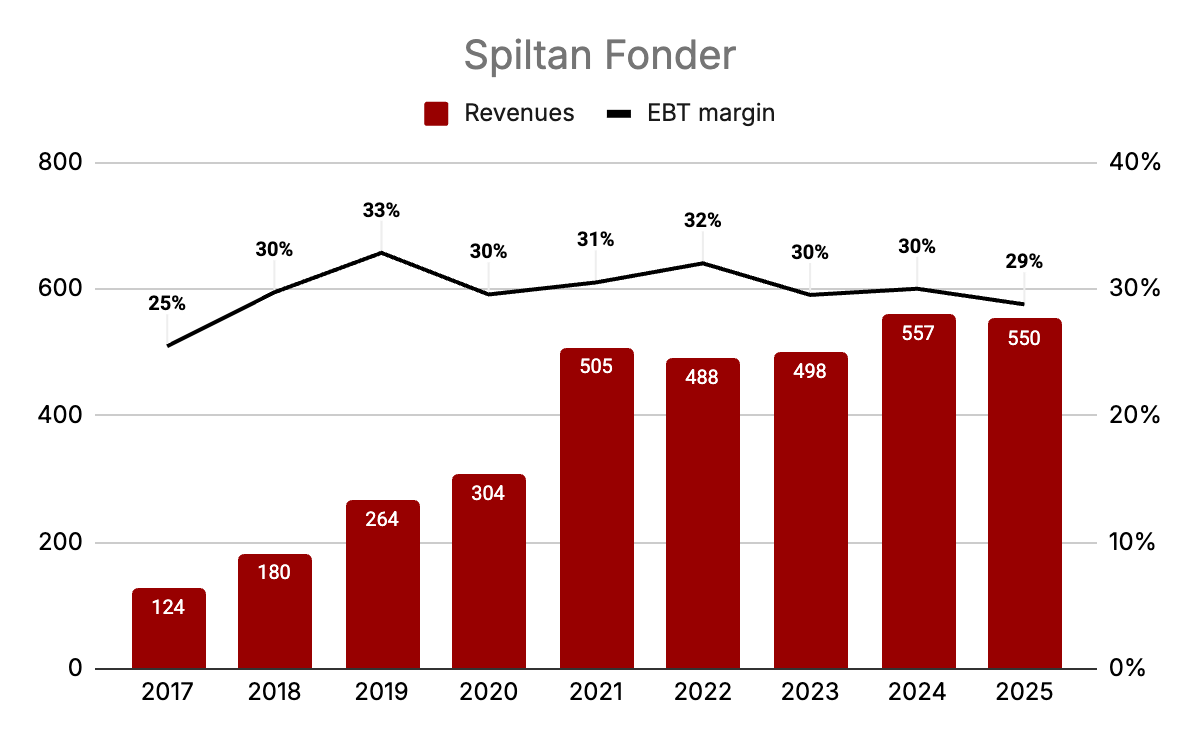
Spiltan Fonder was valued at 1,709 million SEK as of the end of 2025. They have a net cash position of roughly 112 million SEK and runs a highly profitable fund business.
The earnings power of Spiltan Fonder seem to be around 130 million SEK annually currently, with plenty of room to continue growing if they can obtain more market share than 1% of the Swedish fund market. Given the strong momentum (20% revenue CAGR and 30% EBT margin), we think the business should at least deserve a 15x multiple. It seems that many listed peers trade around that 15x multiple.
That would value Spiltan Fonder at 1,950 million SEK in value. At an 89% ownership stake, that translates to 1,750M. Comparing that number to the 1,709M (1,609M as of Q3 26) Spiltan values it at, means we would value the fund business similarly. We find this example illustrating well that there’s no reason to assume Spiltan value their private holdings conservatively or aggressively.
Valuation — Compounding Potential
We believe the key question is not just what discount to NAV Spiltan deserves today, but how much NAV the company can create over the coming years.
To assess this, we have built three scenarios for Spiltan’s NAV development over the next five years. Our NAV growth assumptions represent our estimate of the combined contribution from underlying earnings growth and reinvestment.
On our NAV growth assumptions, which serves a proxy for the underlying earnings growth + dividends, we need an opinion on the different pieces of Spiltan.
For the coming 5 years, we assume in our low, base and high case:
Low case: 8% NAV growth & 30% NAV discount
1) Paradox struggle with new launches, but keep profitability from existing franchises and grow in line with gaming market of 6% annually.
2) Spiltan Fonder grows 12% annually, and keeps taking market share driven by a strong track-record and clear investment strategy.
3) Serial Acquirers grow 11% annually, driven by 80% reinvestment rate and a 14% ROIIC. Their small size enables them to keep acquiring small businesses at low price.
4) Real estate businesses don’t grow.
5) None of the small investments turn successfull.
- NAV discount remain at 30%
Base case: 11% NAV growth & 22% NAV discount
1) Paradox grow 10% annually, also boosted by 1 new succesfull game franchise.
2) Spiltan Fonder grows 15% annually, rapidly taking market share.
3) Serial Acquirers grow 12% annually, driven by 80% reinvestments at 15% ROIIC.
4) Real estate business grow 8% annually
5) 1 of the smaller investment turn a homerun, and becomes a larger position.
- NAV discount narrows to 22%
High case: 14% NAV growth & 15% NAV discount
1) Paradox grow profits by 15% annually, driven by cost efficiencies from AI and succesfull expansion of both existing and 1-2 new titles.
2) Spiltan Fonder grow by 15% annually.
3) Serial Acquirers grow by 15% annually, driven by one of them turning a big winner.
4) Real estate grows 8% annually.
5) 1-2 of the smaller investments turn a homerun, and becomes a material position.
- NAV discount narrows to 15%, as market receive more faith in the portfolio quality.
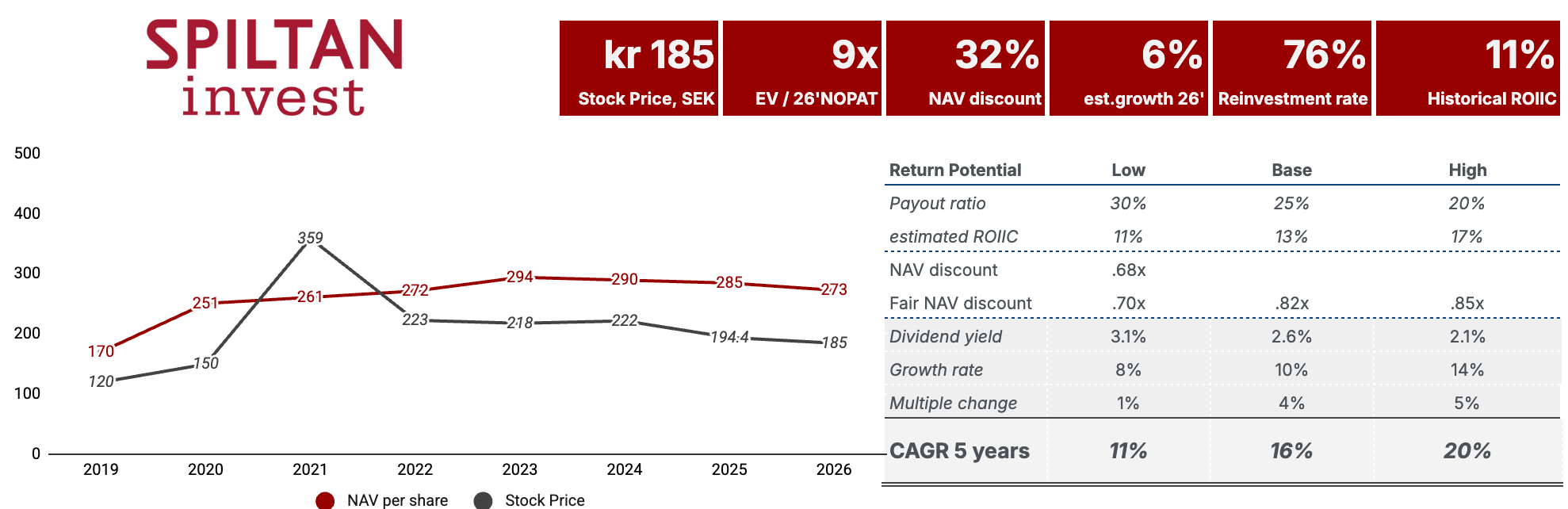
In all 3 models, a tailwind from NAV discount narrowing was assumed. Further, given that share of profits only increased 9% over the last 5 years, these assumptions are relatively optimistic, given that the base case assumes a small improvement from this. To conclude, the combination of 2,5% dividend & buyback yield + 10% growth and 3% multiple tailwind per year, don’t add up to more than 16% CAGR. To us, we already have many positions at such a hurdle rate, but do like when Holding Companies offer such potential returns, as they often come with lower downside risk than individual companies.
Our take — Opportunity or continued slow NAV growth?
There is no doubt that Spiltan has an impressive track record. However, the past three years of virtually no NAV growth have understandably made investors impatient.
We have great respect for management, enjoy reading their annual letters and appreciate their long-term approach to investing. Still, even after holding two investments that became 100-baggers over a relatively short period, total NAV growth has remained in the low double digits. This raises an important question: how repeatable is Spiltan’s investment success?
We haven’t calculated an exact hit rate, but it appears that a meaningful number of investments have failed to deliver. That is not necessarily a problem. A strategy built around many small bets and a handful of exceptional winners can be highly successful. However, we find it difficult to assess whether Spiltan has a repeatable process for identifying these winners or has benefited from a few particularly fortunate outcomes. They seem to have placed a lot of similarly sized bets on a lot of companies, many more than what you can see from the overview section.
The importance of capital allocation
Hit rate is a metric we particularly like when evaluating holding companies. When most NAV growth comes from one or two exceptional investments, forecasting future growth becomes considerably harder. We saw this exact concern when analysing Exor. Ultimately, it becomes easier to underwrite a holding company when you have confidence in management’s ability to allocate capital consistently.
Investor AB provides an interesting contrast. A broader range of its holdings have delivered attractive returns over time, making its value creation more predictable. Its investments are also generally larger and more established than Spiltan’s.
Spiltan takes a different approach. Its small-cap focus allows it to invest early in promising entrepreneurs and owner-operators, with the ambition of finding the next 100-bagger. We believe there is logic to this strategy: make many relatively small investments, accept that some will fail, and hold onto the winners as they scale.
The challenge is that most of these investments remain very small relative to Spiltan Fonder and Paradox. Even a doubling in value would have a limited impact on overall NAV. Several would need to multiply many times before becoming meaningful contributors.
Nevertheless, there are encouraging signs. Spiltan’s investment track record within its fund business is a positive indication of its selection capabilities. Management also appears exceptionally patient, which we believe is a valuable advantage in today’s short-term-oriented market.
Our final take
Despite our reservations about the repeatability of Spiltan’s capital allocation, we find the current valuation interesting.
We are relatively comfortable with Paradox and believe Spiltan Fonder offers attractive fund products with room to grow. We also like the small-cap tilt within its acquisitive industrial holdings, where patient ownership and smaller acquisition targets can create attractive compounding opportunities.
We don’t, however, rely on the smaller investments becoming major winners in our valuation. Instead, we view them as additional upside optionality.
Ultimately, our investment case rests on the existing portfolio delivering reasonable NAV growth, while the smaller investments offer the possibility of something more. We remain uncertain whether Spiltan can repeat its exceptional historical successes, but at today’s valuation, we believe investors are getting an interesting combination of established businesses and potentially significant long-term upside.
For now, we place Spiltan on our watchlist, like we usually do when liking a business. We tend to follow a business for roughly a year on average before buying our first stake. That seem to help us have a higher hit-rate than what we otherwise would if we would jump on every new opportunity we find.
All the best,
Ole
Discussion about this post