
Why “The Outsiders’ Corner”?
I chose this name because, in many ways, I feel like an outsider myself when it comes to finance.
I don’t have a formal background in finance (another reason why you as a reader should think for yourself when reading my ideas). Instead, we’ve learned about business by running two businesses of our own, reading extensively, and accumulating knowledge from books, annual reports, and people we’ve met along the way. We think of this newsletter as our little corner where we can put those ideas together, test them, and discuss them with others.
We’re also fortunate that our work gives us the opportunity to speak with many business owners and investors. The more people we meet, the more convinced we become that there are lessons about business almost everywhere around us.
Originally, this newsletter was simply a way for me to structure my own investment journal. My thoughts were scattered across books, notes, and documents, and writing publicly seemed like a useful way to bring them together. I thought perhaps a few others might find some value in those thoughts too.
I certainly didn’t imagine that 3,805 unique people from around the world would eventually find their way to this
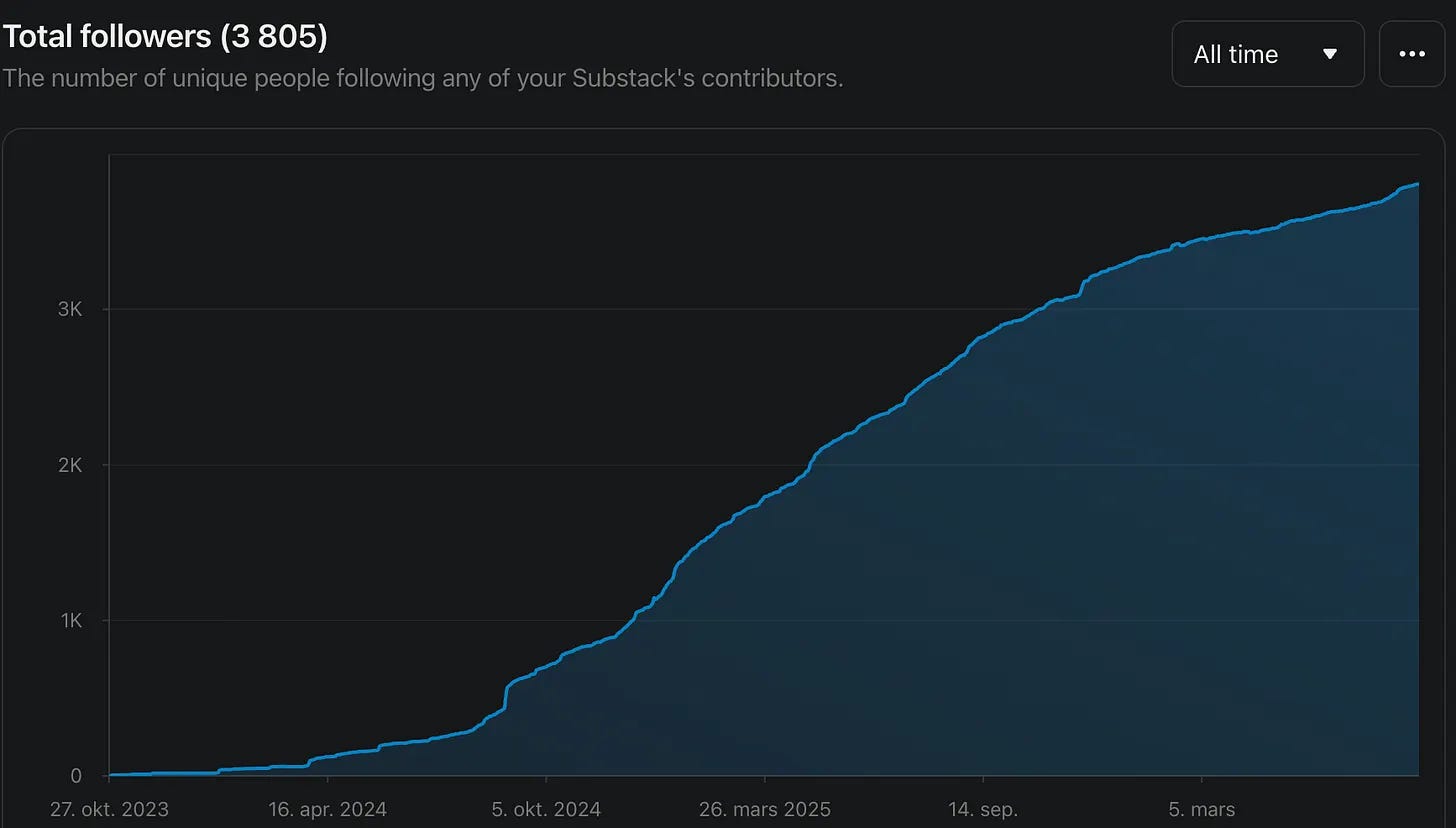
little project.
I’m grateful for every one of you, and I hope to keep delivering more value over time. Increasingly, though, some of the most valuable parts of this corner come from the readers themselves — through ideas you share, businesses you introduce, work you send our way, and discussions that challenge or improve our thinking.
What are we looking for?
We believe there are many ways to invest, and we certainly don’t think we have found the one right answer.
An investment style should fit not only your interests, but also your values, patience, temperament, and the amount of time you’re willing to devote to it. For us, it’s sometimes easier to explain what we’re looking for by describing what we don’t try to do.
First, we don’t do cigar-butt investing.
There’s an obvious appeal to buying a stock at 10x earnings and hoping it rerates to 15x. The problem is that the puff only lasts once. Eventually, you need to find another cigar.
That can absolutely be a worthwhile strategy, particularly when there is a clear catalyst for the rerating and the time-weighted return can be attractive. But it’s not how we prefer to invest.
We only invest if we can see a combination of capital returns + growth over a multi-year period of at least 12%. And the lower that combination is, the more disciplined we aim to be on price. But, if we find a business that we truly want to partner our capital with for decades, we would accept a 12% compounding business vs one that compounds at 15%, if we see it as more durable. Durability is key for us.
We also prefer to find owner-operators — or people who think like owners — who excel at both operations and capital allocation.
That combination is relatively rare.
Sometimes we’re happy to own a cash cow: a business that returns most of its cash flow to shareholders. But ideally, we want management to have opportunities to compound capital without requiring much additional capital. Medistim is a good example of this, who can do both - capital returns + invest in growth.
Secondly, we want to allow ourselves to be wrong.
This is where two factors matter enormously: concentration and leverage.
We don’t employ much leverage ourselves, and we don’t want the businesses we own to depend on fragile balance sheets either.
Concentration is a little more subtle. Our egos can tell us that we are so confident in an idea that we should put all our eggs in one basket.
But doing so creates one fundamental vulnerability:
We can’t afford to be wrong.
We’re not trying to maximize portfolio returns at any cost. We’re trying to compound capital without taking unnecessary risks. We therefore don’t want to risk the whole farm for another acre of farmland.
This makes position sizing one of the most important skills in investing, in our view.
Most educated investors can find good investment ideas if they look for long enough. The much harder task is determining how much to invest in each one.
A high hit rate doesn’t help much if your single largest position is a disaster.
Examples
Our October 2025 write-up of Eurofins showed how management has effectively pursued a “reverse private equity strategy”: buying its own real estate while prioritizing share repurchases over M&A when its own shares are cheap.
A few years earlier, management did the opposite — issuing shares when the proceeds could be deployed opportunistically to acquire hundreds of companies at lower multiples than Eurofins itself was trading at.
The lesson, to us, is less about the specific transactions and more about the capital allocation mindset: the best capital allocators are willing to act differently depending on where the opportunity lies.
Our February 2025 Investor Day update for Shift4 looked at a management team intensely focused on increasing free cash flow per share, including through high-return incremental investments.
Management’s recent move to collapse the share structure, as founder Jared Isaacman steps into NASA while retaining his ownership and continuing to buy shares, is another example of what we view as strong alignment with shareholders.
Norbit, which we discussed in our Industrial Writeup, is perhaps the most textbook “Outsider” business of the group.
With significant insider ownership and a lean, decentralized headquarters, it operates far from the noise of financial media. By keeping production in rural Norwegian communities, Norbit has built a low-cost, high-discipline culture that is now winning major orders from Europe’s defense giants.
What once looked like a contrarian decision — keeping manufacturing in-house and in Norway — has increasingly become a competitive advantage.
Mid-twenty-percent EBIT margins and even higher ROCE are not characteristics of an average industrial company.
MBB (our early-2025 write-up here) looks, at first glance, like a rather boring German conglomerate.
We see something different: a superior management team with a proven capital allocation track record and a preferred-owner position among German family businesses looking to retire.
The Friedrich Vorwerk transaction, in particular, stands out as perhaps the most value-creative deal we have ever witnessed.
These four companies are very different businesses. Yet they share the characteristics we look for, and they are businesses we would like to partner with for a long time.
Our investment strategy therefore does not simply revolve around buying great companies at low prices.
Our Investment Strategy
We want to partner with owner-operators who know how to create value, have an extensive track record of doing so, and still have significant whitespace ahead of them.
We typically hold between 8 and 20 stocks and invest all of our personal savings alongside our readers. Importantly, we usually keep somewhere between 5–25% of our assets in cash, which gives us the ability to act opportunistically when one of these businesses goes on sale. We also maintain a relatively short watchlist of businesses we follow closely.
So far, 19 of our 33 total stock investments have generated more than 8% annualized returns. Our biggest realized loser contributed -2% to invested capital. We currently have one position with an -8% contribution — painful — but we believe it is significantly underpriced and have therefore continued to buy shares, slowly catching the falling knife.
Our money-weighted CAGR since inception in late 2021 is currently around 14%, as of February 15, 2026. Following the significant selloff in many of our holdings, including the position mentioned above, we are currently reducing our cash allocation and investing more.
If we expect our managers to act counter-cyclically — as Eurofins illustrates — we think we should try to do the same when the opportunity presents itself.
Cheers,
Ole