

In this month’s letter, we’ll share a lesson we learned this month, recent updates to a few of our Holdings having reported and our Portfolio Holdings as of writing this.
We hope you’ve had a wonderful summer, and look forward to share more writeups over this autumn.
All the best,
Ole
Introduction
This month we did a deep dive on Alternative Asset Manager EQT. Two things made us interested in researching the company.
Investor AB, a key holding of ours, increased their stake in EQT recently.
Since EQT purchased a large stake in OEM International, the business have improved — turning a high-quality low reinvestment business into one with higher reinvestments, and thus also more growth. Solving the problem we outlined with OEM when we covered it as a standout in the Serial Acquirers writeup of 2024.
OEM is an error of omission from our side, with the stock up 48% since that writeup. Luckily, we’ve had other great picks, like Investor AB — a key owner of EQT, where we indirectly benefitted from the rise in OEM’s value — through their ownership in EQT.
EQT surprised us in several ways — partnerring with a house of investors’ having earned 15-20% IRR’s does not sound to bad an idea.
We also had 2 other writeups this month — an update for Investor and our 5 best ideas currently. You can find the link to all these below if you’re interested.


This month’s key Lesson
During July, we’ve learned to appreciate how quantitative metrics should rarely be viewed in isolation. Best Anchor Stocks recently analyzed the Fundsmith letter, where Fundsmith’s decision to update their strategy of “doing nothing”. Now, they’ll implement a more momentum-based strategy. What fewer took notice of, but Leandro pointed out, was Fundsmith’s mistake in optimizing for ROIC alone.
Leandro’s observation made something click for us, when we tuned into the earnings report of Eurofins this week, where their CEO called out a similar dynamic, but for a different figure (organic growth).
”We’ve ended a lot of loss-making contracts there (referring to the acquisition of Synlab). That also impacts our organic growth, of course, when we do that. We focus on business that is profitable long term and clients that are prepared to pay so their providers make an acceptable profit”.
— CEO G.Martin of Eurofins in Q2 2026
The lesson here is that organic growth combined with margins makes for a better understanding of the development within the business. This is one of the key reasons behind how Eurofins grow adjusted EBITDA by 8%, in a quarter with only 2,9% organic growth (even lower if not adjusting for currency headwinds).
Consequently, investors should consider organic growth together with margins. Taking down unprofitable business can be a rational decision even if it hurts organic growth short term.
Lifco is another great example of this exact dynamic. They deliberately track organic EBITA CAGR instead of organic sales growth. One of the reasons behind their incredible margin expansion over the years, resulting in profits growing faster than sales, is their deliberate action to remove less profitable business lines.
Investors recognizing Lifco’s excellence in capital allocation, would have been well rewarded — as you can imagine from the profit growth and strong margins below.
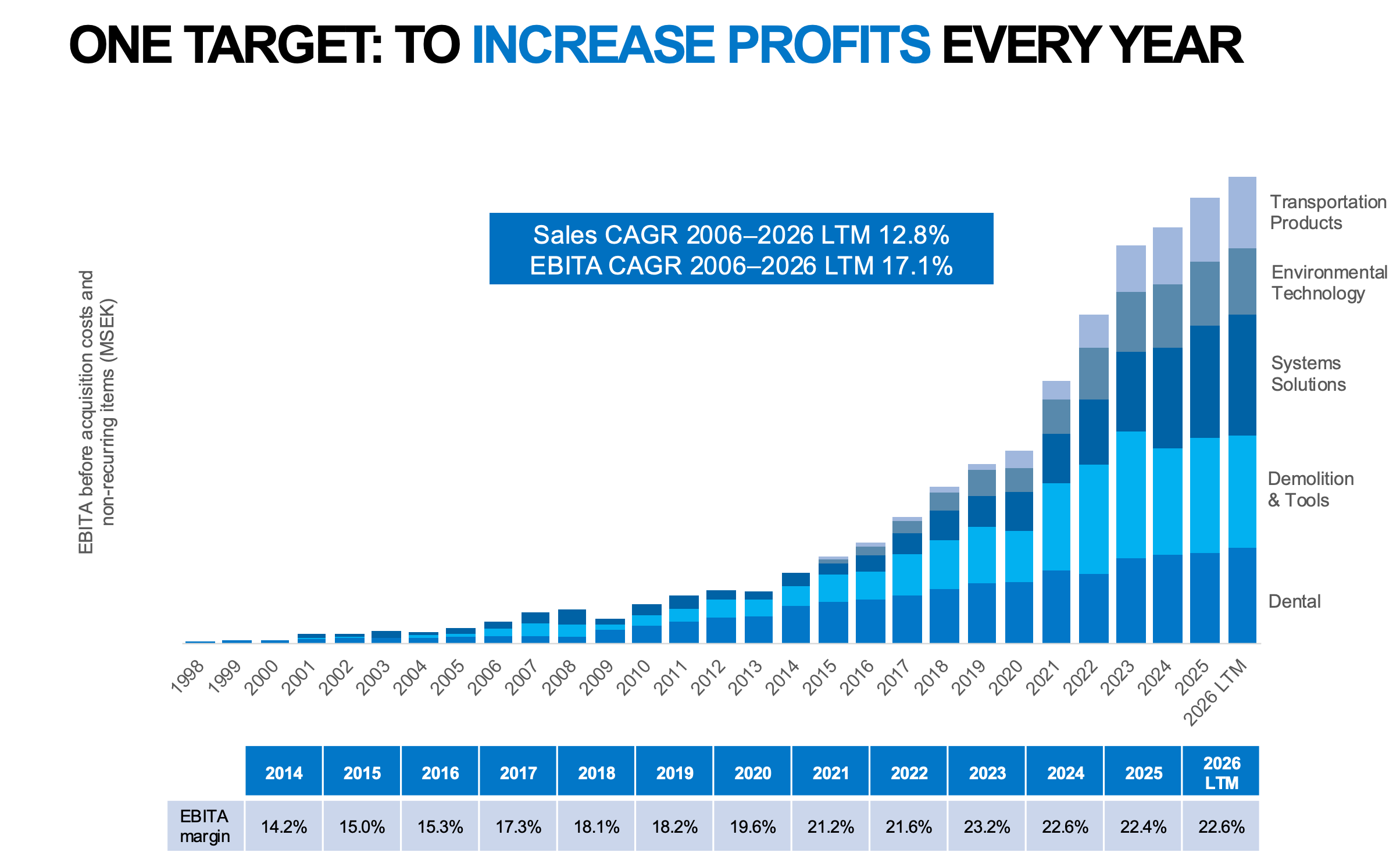
We think this lesson is particularly relevant for incentive structures. If a board incentivize their management team on organic growth alone, a logic that seem feasible at first thought, that would actually incentivize not removing “the weeds”.
And in the stock market, you’re typically rewarded for having more flowers than weeds — something investors owning deeply discounted Holding Companies can relate to, with management teams often compensated on NAV growth. It’s a different, but also somewhat similar dynamic.
We prefer our Holding Companies, and individual businesses, to optimize their portfolio over team — watering the flowers and removing the weed.
A master Capital Allocator in Mark Leonard of Constellation Software, brilliantly combined the idea of combined metrics with: ROIC + organic growth. The beauty of this model, is how it captures both profitability, capital returns (also from acquisitive spend) and durability (organic growth) in one number. Return on capital and margins compensate for the drawdowns of looking at organic growth alone, and vise versa.
Genius is making complex ideas simple, not making simple ideas complex.
— Albert Einstein
H1 2026 updates
Several companies have reported H1 results so far, and we wanted to cover these before going over our usual Portfolio Update.
First out, our Holding Company MBB. It includes a business laying underground pipes, a cybersecurity player, a production line equipment business, polish toilet paper and one specialized wood producer, recently expanding into cork within batteries. And a lot of cash, which is partly invested in bonds, liquid large securities and gold.
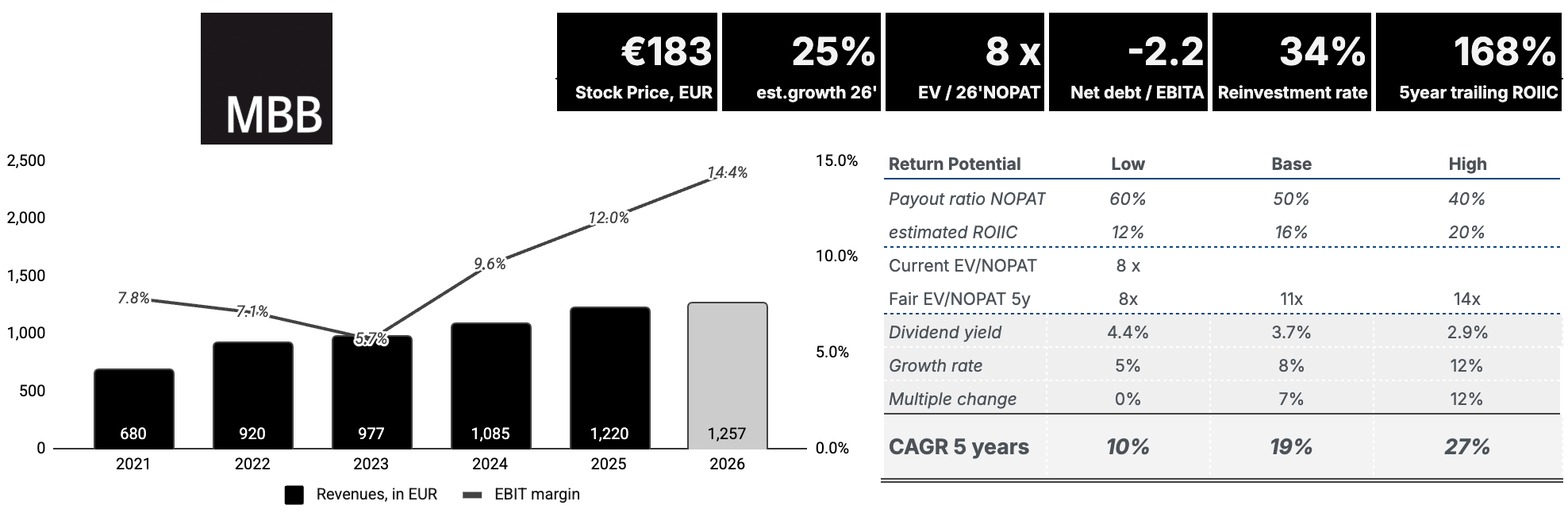
MBB’s preliminary numbers on the 22nd of July, surprised us positively. EBITDA margins of 25,1% for the quarter and 21,8% for the half-year, up 700 basis points compared to H1 2025 (14,8%). That margin expansion, meant we had to increase our margin estimates for the full year, and now see 25% profit growth.
At a valuation of 8x EV / NOPAT (FY26), roughly 1-2% dividend yield, 3-4% share buybacks and a net cash position almost 50% of market cap, MBB delivers a unique combination of growth, capital returns and optionality currently.
MBB remains a top 3 holding of ours, and publish their full H1 report on August 13.

Next out is a Scandinavian Brokerage Platform, in the process of expanding to Germany — an investment that could lengthen their reinvestment runway. Still, they have lower hanging fruits too — like capturing market share within pension accounts.
